Personal AI
Instinct vs Muse vs Lucie
Personal AI is beginning to split into different futures, each with a different idea of what intelligence should actually do for your life.
The personal AI race just caught fire.
In a matter of days, Silicon Valley has been flooded with demos of AI booking restaurants, answering emails, buying products, planning trips, managing calendars and navigating the web. Instinct has become one of the most talked about personal AI assistants in tech circles, with users showing it completing real-world tasks, from booking cabins to dealing with customer service.12
Then Meta entered the race with Muse. Muse can connect to email, calendars, payments, shopping and other services, operate a browser, continue working in the background and take actions on behalf of its user. Meta describes it as a personal AI agent built to take work off people’s plates.34
We are finally moving from AI that answers
to AI that acts.
Beneath the excitement, something more consequential is happening. Personal AI is starting to split into different philosophies, and the split is not about who can send an email two seconds faster. It is about what the intelligence is ultimately trying to help a person achieve.
Muse and Instinct are evidence that the category has arrived.
For years, the idea that everyone could have a deeply personal intelligence working alongside them sounded like science fiction. It doesn’t anymore. Meta is openly describing Muse as a step toward personal superintelligence,75 and Instinct is showing how quickly people become comfortable delegating pieces of their lives to an agent.1
Both make the category legible to people who had never considered it, and both raise the bar for what a personal system is expected to do. What they leave open is the question this essay explores: what kind of personal intelligence people will choose once the novelty of delegation wears off.
The first generation of personal AI is obsessed with getting things done.
Most of the demos circulating today revolve around the same promise: send the email, buy the product, book the flight, find the restaurant, cancel the subscription, research the company or schedule the meeting without having to do it yourself.
These are genuinely useful capabilities. Instinct has attracted attention precisely because it turns requests into actions instead of explaining how you could perform them yourself.2 Muse pushes the same idea further with Meta’s ecosystem and distribution: it remembers relevant details, makes suggestions without being prompted and works toward longer-term goals.3 A chatbot competes for your questions. An agent asks for your accounts and your permission, then carries a task from intention to completion while you do something else. Anyone who has spent an evening on hold with a customer service line understands the appeal.
But there is a question the industry needs to sit with before the category hardens around its first instincts. Is getting more things done the ultimate purpose of personal intelligence?
We spent twenty years optimising technology for attention. Now we risk optimising AI only for productivity.
Every intelligent system optimises for something, whether or not anyone chose it deliberately. The last generation of consumer technology optimised to capture your attention, and it became extraordinarily good at it: feeds more addictive, notifications more sophisticated, recommendations more personalised, advertising more targeted. None of it was designed to make anyone miserable. It was designed to maximise a metric, and the metric was indifferent to how the captured hours were spent.
And now an entire generation is paying the price. Almost half of American adults say they feel addicted to their phones.9 We were told technology connected the world, yet more than a billion people report feeling lonely.10 Our children are paying the highest price: American teenagers now spend around eight and a half hours a day with screens outside school.11
Did technology serve us, or did it enslave us?
We should ask ourselves whether hiring some of the most brilliant minds of our generation to engineer increasingly addictive algorithms was really what we needed as a society.
Agentic AI is arriving with a different metric: productivity. Answer more emails. Process more information. Complete more tasks. Move faster. Productivity is good, and the products delivering it deserve their momentum. The risk is quieter than productivity itself. It is that an easily measurable metric becomes the objective, the way attention once became the definition of a good product.
Productivity should be a means.
Not the destination.
At the end of a life, very few people will wish they had answered another ten thousand emails. They may wish they had called their mother more often, slept better, taken care of their body, maintained their friendships, spent more evenings with the person they love, or taken steps to pursue their true calling.
They may wish they had protected their attention, taken the trip they kept postponing, or simply been more present for the life happening around them. Productivity matters because it can make room for those things. It turns dangerous when doing more quietly becomes the point.
Personal AI can optimise for those things too. That is where the category begins to split.
Personal assistant vs personal agent vs LifeOS.
Today these products are placed in one large category called personal AI. We don’t think the description will survive contact with the products. A spreadsheet, a CRM and a social network are all software, but the word tells you nothing about what each is designed to accomplish or how it behaves when its interests and yours diverge.
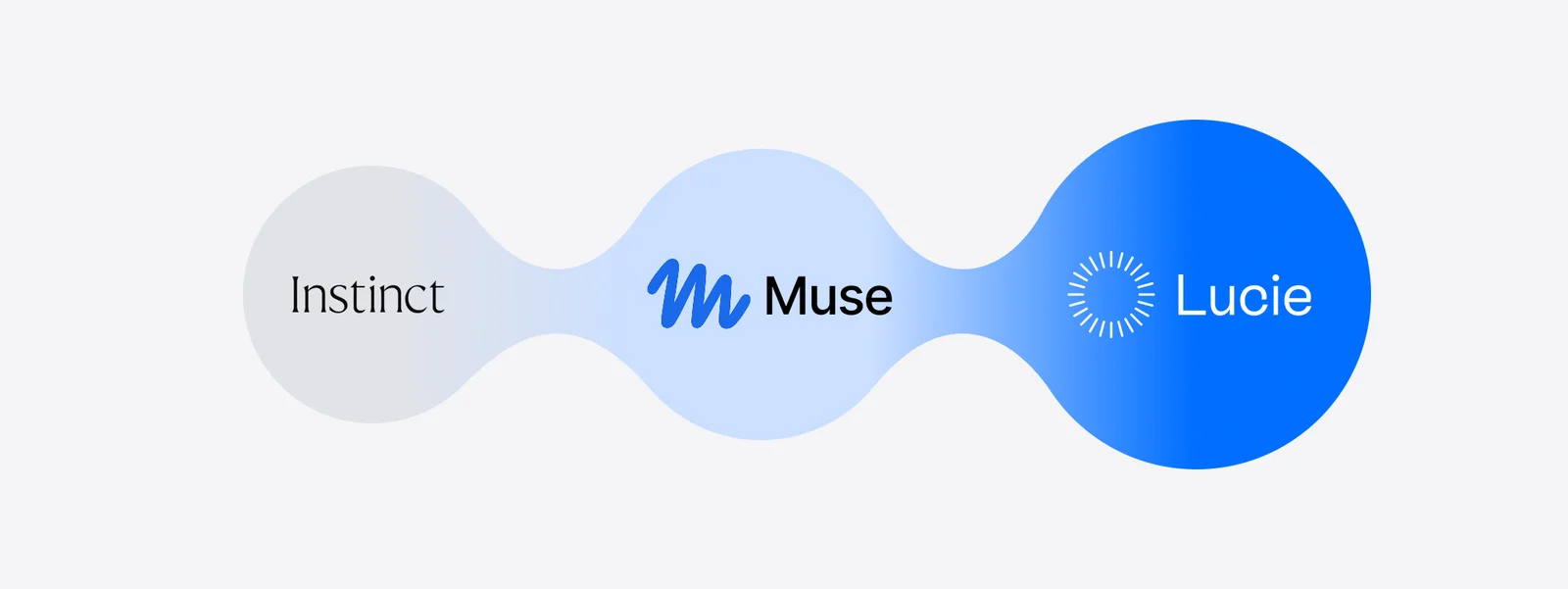
Three shapes are already visible. Instinct is a personal assistant, built to reduce friction and complete tasks with the least possible attention from you. Muse is a personal agent, built to pursue goals across a broad digital ecosystem and keep working when you close the app. Lucie is a LifeOS, built to understand the person and help them live more intentionally.
A LifeOS does not start from what it can get done for you. It starts from what matters in your life and how intelligence can help you live more of it, which changes everything downstream: what the product asks to connect to, what it pays attention to, when it speaks and, just as often, when it stays silent.
Instinct vs Muse vs Lucie.
| Instinct | Meta Muse | Lucie | |
|---|---|---|---|
| Core idea | Personal AI assistant | Personal AI agent | Personal LifeOS |
| Primary orientation | Completing tasks with minimal friction | Pursuing goals across your digital life | Helping you live more intentionally |
| Primary interface | iMessage / messaging platforms | Dedicated app + Meta ecosystem | Dedicated iPhone + Mac apps |
| Personal context | Connected email, messages, calendar and devices1 | Connected apps and services, remembered details3 | Signals across attention, body, calendar, people, reflections and work |
| Health and body | Not the core thesis | Health connections supported4 | Core pillar |
| Attention and relationships | Context for assistance | Context and personalisation | Core pillars |
| Proactivity | Tasks and follow-ups | Unprompted suggestions and long-running goals3 | Notices patterns across your life and speaks when it matters |
| Purpose and impact | Not the core thesis | Commerce, goals and tasks | Core pillar: the person you said you wanted to become |
The Instinct and Muse columns summarise each product’s public positioning as of September 12, 2026; the sources are listed at the end. The Lucie column is ours.
Imagine the difference.
Your calendar knows you went for a run with Michael on Tuesday. Your wearable knows the effort: meaningful time in Zones 4 and 5. Your sleep data knows what came afterwards: the last four times, you slept roughly 35 minutes longer that night. None of them knows what the others know. Lucie connects them.
A traditional assistant sees an event it can move, cancel or rebook. A LifeOS can begin to see that this activity, with this person, is good for you, and turn it into a small piece of self-knowledge you did not have to work for.
The last four times you went for a run with Michael, you slept around 35 minutes longer that night. Want me to draft an invite for next week?
The same reading works on a harder day, when attention, body, work and the people in your life all pull at once.
This is why context may become more important than the model.
Today’s AI conversation is obsessed with models: which is fastest, which tops the benchmark, which completes a browser task most reliably. Those things matter today, and the models are improving extraordinarily quickly. Meta says Muse is powered by Muse Spark, its most capable model, built for real-world agentic work.38 The underlying intelligence will keep getting better, for everyone, at once.
Which points to something the benchmark charts miss. Frontier capability is expensive to build and cheap to rent, and within a few years most products will sit on intelligence that would seem miraculous today. What cannot be rented is the understanding accumulated around a person: their preferences and routines, the relationships that steady them, the health patterns that predict a rough week, the reflections written at midnight, the commitments made and quietly broken, and the things they keep saying matter but never make time for. That understanding is not a score. It is what turns a general intelligence into a personal one, and it compounds, becoming harder to replace and more valuable every month it exists.
The enduring layer may not be the model. It may be the context layer above the models.
A LifeOS should be built to use increasingly capable intelligence underneath while preserving, and protecting, the understanding that accumulates on top. The model can be swapped. The context is the product.
Who does your personal AI serve?
If that context becomes the most valuable layer, then who owns it and what it is used for become the defining questions. An intelligence that holds your email, calendar, health, purchases, location, relationships and reflections may understand your everyday life better than almost any individual person does. Privacy protects the data. Alignment governs what the system does with the understanding it builds from it, and the second matters at least as much as the first.
Meta has built substantial protections into Muse. The company says it runs inside a dedicated secure virtual machine (VM), requires permission for consequential actions, lets people control which services it connects to and does not share Muse conversations or VM data with Meta’s advertising systems, with a future Confidential VM encrypting data under a key held by the user.36 Those are meaningful decisions. They also leave open a question no architecture can settle: who should ultimately control the intelligence built from your life. Early reporting on Muse makes the stakes concrete, since using it means trusting Meta with more personal information than ever before.4
None of this is an accusation. It is how incentives work over time. A product is shaped by what its company needs it to become, and a personal intelligence inside an attention and commerce business will feel that pull over the years, however sincere its launch-day protections. The question is structural, and it applies to every company in this category, ours included. People will come to care about ownership, portability, business model and alignment as much as encryption: whether the understanding built from their life is theirs, whether they can take it with them, and whether the company holding it makes money in ways that reward keeping it private. We believe the long-term direction moves toward greater user ownership, including more intelligence and context processed locally on personal devices as the technology allows.
Your life should remain yours.
The benchmark for personal AI needs to change.
Today we benchmark agents on task completion: did it make the purchase, answer the email, book the flight or finish the browser task? Imagine another generation of benchmarks.
- Did it help someone sleep better?
- Did it help them protect time that would otherwise have disappeared into their phone?
- Did it help them spend more time with people they love?
- Did it help them become the person they said they wanted to become?
These outcomes are harder to measure than a completed checkout, and they resist the tidy percentages that make a chart look convincing. They are also much closer to the actual purpose of technology, which is improving human life.
From artificial intelligence to personal intelligence.
The first wave of AI helped us know more. The second helped us create more. The current generation is helping us do more. The next may help us live better.
The ultimate personal AI should not simply help you complete more tasks. It should help you live a fuller life.
That is what we mean by a LifeOS. What kind of intelligence do we want beside us?
Talk about this with us