Wearable Accuracy Report 2026
Most accurate wearable 2026
Oura vs Apple Watch vs WHOOP vs Garmin vs Fitbit, judged against laboratory reference measurements in peer reviewed research.
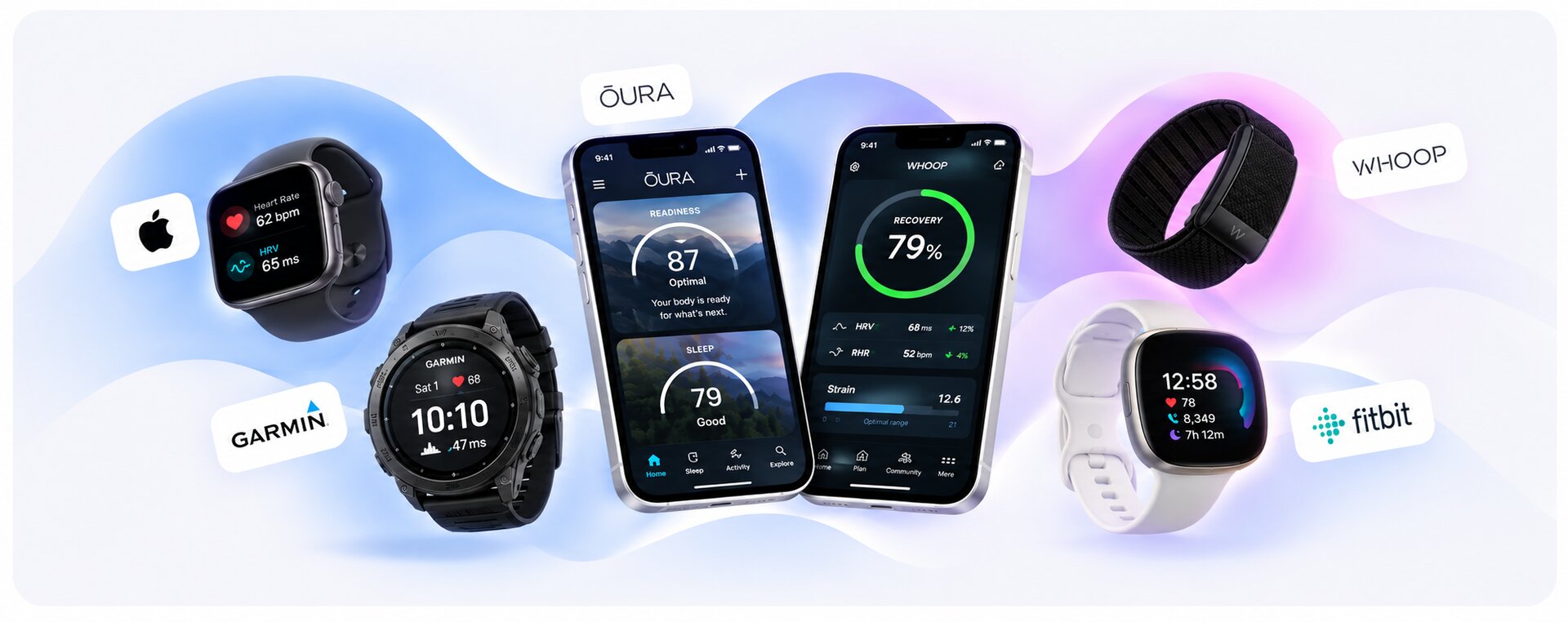
Every wearable is tested the same way: against the instrument science treats as the truth for that signal. Polysomnography for sleep. ECG for heart rate and HRV. A metabolic cart for VO₂ max. Indirect calorimetry for calories. We read the peer reviewed studies that did this for Oura, Apple Watch, WHOOP, Garmin and Fitbit, checked every figure against the original paper, and kept the tables comprehensive so you can scan instead of read.
Which wearable is most accurate, by measurement
| Metric | Best supported | Runner up | Evidence confidence |
|---|---|---|---|
| Sleep | Oura Gen 3duration within 10 min of the lab; best staging in healthy sleepers | Fitbit Sense 2most stable staging across populations; Apple Watch S8 led the largest independent wrist study | Moderate |
| HRV | Oura Gen 4 and Gen 3CCC 0.99 and 0.97 vs ECG overnight | WHOOP 4.0CCC 0.94 | Moderate |
| Resting heart rate | Oura Gen 3 and Gen 4within about 2% of ECG | WHOOP 4.0within about 3% | Higher |
| Exercise heart rate | Apple Watchmost consistently validated wrist device | Fitbit Charge 6best of ten devices in the newest test; recent Garmin close | Moderate |
| Steps | Apple Watchaccurate in the lab, moderate in free living | Fitbitaccurate in the lab, undercounts outside it | Moderate |
| Calories | No winnerevery review finds no brand accurate | None | Higher, that none is accurate |
| VO₂ max | Garminabout 7% error, exercise based | Apple Watchunderestimates by about 6 mL/kg/min across three generations | Moderate |
| SpO₂ | Apple Watch Series 7closest to a clinical oximeter in the one head to head study | None namedGarmin read low; Oura, WHOOP, Fitbit untested | Low |
| Temperature | No winnerno comparative validation exists | None | Insufficient |
How to readBest supported device per metric across the evidence reviewed. "Confidence" grades the evidence, not the product. Device generations are named because results do not transfer between them.
GradesHigher = several independent studies agree for a current device. Moderate = strong but single study, small sample or older hardware. Low = one study or conflicting results. Insufficient = no comparable peer reviewed evidence. Sources cited in each section.
Make this page about you.
Pick your wearable and what describes you. The tables will highlight what applies to you.
Your wearable
What describes you choose any
There is no most accurate wearable. There is a most accurate wearable for a particular measurement.
Can you trust the change you’re seeing?
Even when a wearable is reasonably accurate, small changes can still fall within its normal measurement error. Enter your usual value and today’s value to see whether the difference is larger than the error reported in published studies.
Is this change bigger than your wearable’s usual error?
Your device
Measurement
How to readThe shaded band is your usual value plus or minus the typical single reading error measured for this device and metric in the studies cited on this page. If today's value sits inside the band, the difference is probably within the device's normal measurement error. If it sits outside, the change is larger than that error, which says the device can resolve it, not why it happened. Percent errors use MAPE; minute errors use mean absolute error, or an estimate from the reported spread where stated. Not a medical tool.
What the statistics in the tables mean
Bias is the average difference from the reference; limits of agreement show the range most single readings fall in. MAPE is average percentage error; under 10% is a common "acceptable" bar. CCC is concordance with the reference, where 0.90 and above is strong. Cohen's kappa is chance corrected agreement on sleep stages: 0.21 to 0.40 fair, 0.41 to 0.60 moderate, 0.61 to 0.80 substantial; two human scorers agree at about 0.75.1 Sensitivity is the share of true sleep called sleep; specificity is the share of true wake called wake.
Where the devices actually differ.
Which wearable has the most accurate sleep tracking?
Sleep accuracy is three questions: how long you slept, whether wake inside the night was caught, and whether each 30 seconds was labelled correctly as light, deep or REM. Every device answers the first well and the second poorly, because lying still while awake looks like sleep to a sensor. The third is where brands differ, and where the population matters more than the brand: Oura Gen 3 scored κ 0.65 in the Oura funded study of healthy sleepers and 0.31 to 0.35 in two independent clinical samples.234 Fitbit's staging moved least between populations. Apple Watch Series 8 led the largest independent wrist study and fell to fair agreement in people with sleep complaints.1
Sleep tracker accuracy vs polysomnography
| Device | Study and population | Sleep stages | Deep sleep | REM | Total sleep time | Sleep and wake caught |
|---|---|---|---|---|---|---|
| Oura Gen 3 | Robbins 2024, 35 healthy adults, 1 night2Funded by Oura | κ 0.65 | 79.5% | 76.0% | -9 minnot significant | Sleep 95%Wake 69% |
| Oura Gen 3 | Svensson 2024, 96 healthy adults, up to 3 nights at home5Authors supported by Oura | 75 to 91% per stagenot reported as kappa | see paper | -4 to -6 min | Efficiency -1.1 to -1.5 pts | Sleep 94.5%Wake 73% |
| Oura Gen 3 | Lee 2023, 53 adults with sleep complaints3Authors hold stock in a rival sleep app | κ 0.35 | 77.8% | 71.2% | not reported | Wake 38%sleep not reported |
| Oura Gen 3 | Herberger 2025, 31 sleep clinic patients, first night of wear4Independent | κ 0.3153% four stage accuracy | -6 min bias | +32 minoverestimated | +12 minsingle nights -54 to +98 | Wake 46%85% overall |
| Apple Watch S8 | Schyvens 2025, 20 adults, many with sleep apnoea1Independent; 15 of 35 recordings lost | κ 0.53 | 50.7% | 68.6% | +20 minnarrowest limits of six | Sleep 96%Wake 52% |
| Apple Watch S8 | Robbins 2024, 29 healthy adults2Funded by Oura | κ 0.60 | 50.5%-43 min bias | 82.6% | +8 minnot significant | Sleep 97%Wake 52% |
| Apple Watch S8 | Lee 2023, 26 adults with sleep complaints3 | κ 0.30 | 41.3% | 42.8% | not reported | Wake 45%sleep not reported |
| WHOOP 4.0 | Schyvens 2025, 40 adults1Independent | κ 0.37 | 69.6%+31 min bias | 62.0% | +24 minlimits -101 to +150 | Sleep 94%Wake 40% |
| Garmin Vivosmart 4 | Schyvens 2025, 25 adults1Independent; older hardware; 18 of 43 recordings lost | κ 0.21 | 47.5% | 33.1% | +38 min | Sleep 96%Wake 29% |
| Fitbit Sense, Charge 5 | Schyvens 2025, 37 and 39 adults1Independent | κ 0.42, 0.41 | 50.9%, 51.5%no significant bias | 61.3%, 60.0% | +6, +11 minneither significant | Sleep 93%, 92%Wake 49%, 48% |
| Fitbit Sense 2 | Robbins 2024, 33 healthy adults2Funded by Oura | κ 0.55 | 61.7%-15 min bias | 67.6% | -3 minnot significant | Sleep 95%Wake 68% |
| Fitbit Sense 2 | Lee 2023, 26 adults with sleep complaints3 | κ 0.42 | 67.1% | 68.1% | not reported | Wake 27%sleep not reported |
What this meansHow long you slept is the number to trust; on a single night the stage labels can be half wrong and lying awake is usually counted as sleep. A multi week change on the same device carries information; last night's "42 minutes of deep sleep" does not, and no consumer device diagnoses a sleep disorder.1710
How to readEpoch by epoch agreement with the laboratory standard. Kappa is four stage agreement; deep, REM, sleep and wake are the share of true epochs the device caught; total sleep time is the average bias. Blue marks the best value within a study.
Sources
Schyvens 2025 · Robbins 2024 · Lee 2023 · Herberger 2025 · Svensson 2024. Values are per study and never pooled. Earlier generations scored lower: Apple Watch Series 6 reached κ 0.20 in 2022.6 Earlier Oura generations were validated separately,1112 and newer studies increasingly follow a standard testing framework.13 Reviews of Fitbit, Garmin and WHOOP sleep tracking and a 2025 Oura meta analysis reach compatible conclusions.89
Which wearable has the most accurate heart rate and HRV?
Overnight is the easy exam: the body is still, the pulse is slow, and rings and straps land within a few beats of a medical ECG. Exercise is the hard one, and the error grows with irregular arm movement and rapid changes rather than with intensity.2126 For HRV, one study has tested several current devices against ECG under identical conditions; its ranking is clear but rests on 13 people.14 Apple Watch reports a different HRV statistic from spot readings, so it cannot sit on the same scale, and no comparable Fitbit evidence exists.
Heart rate accuracy vs ECG
| Device | Condition | Result | Study and sample | Caveat |
|---|---|---|---|---|
| Oura Gen 4 | Resting, overnight | CCC 0.98 · MAPE 1.9% | Dial 2025, 13 healthy adults, 536 nights14Independent | Gen 3 nearly identical: CCC 0.97, MAPE 1.7%. |
| WHOOP 4.0 | Resting, overnight | CCC 0.91 · MAPE 3.0% | Dial 202514 | Garmin Fenix 6 could not be analysed for resting heart rate in this study. |
| Apple Watch | Rest to high intensity, pooled | Small underestimationvariability widens at high intensity | Lambe 2026, living meta analysis of 82 studies19Independent | Heart rate was the best supported Apple Watch metric in the review. |
| Apple Watch | Treadmill, healthy adults | CCC 0.91Fitbit Charge HR 0.84; chest strap 0.99 | Wang 2017, 50 adults23Independent | First generation hardware; the comparison later studies cite. |
| Apple Watch S3 | Cardiac rehabilitation, cycling and treadmill | CCC 0.80chest strap 0.99 | Etiwy 2019, 80 cardiac patients24Independent | Includes patients with arrhythmia; 40 wore the Apple Watch. |
| Fitbit Charge 6 | Rest, stress task, steady and intermittent walking | MAPE 5.5% · CCC 0.93best of ten devices | Gielen 2026, 45 healthy adults20Independent | Fitbit Inspire 3 was among the worst (MAPE above 11%). Model matters more than brand. |
| Garmin Vivoactive 5, Vivosmart 5 | Same protocol | Performed wellespecially in steady walking | Gielen 202620 | Behind the Charge 6 and Pixel Watch 2 (MAPE 6.7%). |
| Oura Gen 3 | Same protocol | MAE 9 to 14 bpm · MAPE above 11% | Gielen 202620 | Widest limits during irregular activity. A ring is not a workout heart rate monitor. |
| Fitbit Charge 5, Sense 2 | Rest and varied walking vs 12 lead ECG | Highest accuracy of the wrist devices | Van Oost 202521Independent | Every wrist device lost accuracy when heart rate changed quickly. |
| Garmin Vivosmart 4 | Same protocol | Most stable during transitions | Van Oost 202521 | Older hardware. |
| WHOOP 4.0 | Same protocol | Acceptable at steady stateless accurate during rapid changes | Van Oost 202521 | The only recent independent daytime ECG test of WHOOP we found. |
| All brands | Controlled settings, pooled | Within about 3% on averageApple Watch and Garmin most accurate; Fitbit tends to underestimate | Fuller 2020, review of 158 publications18 | Literature to 2019. Six of seven 2016 era devices were under 5% median error in Shcherbina 2017.25 |
How to readResting rows are overnight against an ECG chest strap. Exercise rows are against ECG or an ECG chest strap during activity. Blue marks the best value within a study.
Sources
Dial 2025 · Lambe 2026 · Wang 2017 · Etiwy 2019 · Gielen 2026 · Van Oost 2025 · Fuller 2020 · Shcherbina 2017 · Bent 2020. Apple Watch 7 and Galaxy Watch 4 were also tested against 12 lead ECG in 44 coronary patients in 2023.22
HRV accuracy vs ECG
| Device | CCC | MAPE | Study and sample | Interpretation |
|---|---|---|---|---|
| Oura Gen 4 | 0.99 | 5.96% | Dial 2025, Polar H10 ECG, 13 healthy adults, 536 nights14Independent | Near perfect agreement in the authors' scale. |
| Oura Gen 3 | 0.97 | 7.15% | Dial 202514 | Substantial. Consistent with earlier Oura ECG comparisons.1516 |
| WHOOP 4.0 | 0.94 | 8.17% | Dial 202514 | Moderate, with a wide spread on the percentage error. |
| Garmin Fenix 6 | 0.87 | 10.52% | Dial 202514 | Poor in the authors' scale. Hardware two generations old. |
| Polar Grit X Pro | 0.82 | 16.32% | Dial 202514 | Context only; not one of the five brands here. |
| Apple Watch S9, Ultra 2 | Not comparable | Not comparable | O'Grady 2024 examined serial HRV and resting heart rate17 | Apple reports SDNN from spot readings, not nightly rMSSD. |
| Fitbit | Not found | Not found | No nocturnal HRV validation against ECG located | Not enough independent evidence. |
What this meansOvernight resting heart rate and HRV from a ring or strap are close enough to ECG that the gap between brands is a beat or a few milliseconds, smaller than your own night to night variation. During exercise, trust a wrist for steady running and walking and a chest strap for intervals, and compare HRV only with your own baseline on your own device, never across brands.
How to readNocturnal HRV against ECG R to R intervals. One study, five devices, identical conditions, which is what makes the numbers comparable.
Sources
Dial et al. 2025, Physiological Reports, no industry funding disclosed. Newer hardware from every brand has not been through this comparison.
How accurate are wearable step counts and calorie estimates?
These two share a sensor and nothing else. Step counting is solved on a treadmill and moderate in daily life, where a coffee cup confuses every wrist. Calories are not measured at all: they are modelled from heart rate, movement and an equation, and every systematic review that has compared the model with indirect calorimetry reaches the same verdict.182831
Step count accuracy
| Device | Laboratory walking | Free living | Study | Caveat |
|---|---|---|---|---|
| Apple Watch | Accurate | Moderate accuracy | Fuller 2020; Lambe 20261819 | Slow and shuffling gait raise error on every wrist device. |
| Fitbit | Accurate | Tends to undercountCharge models MAPE under 25% across 20 studies | Fuller 2020; Germini 2022; Chevance 2022182830 | The most studied brand, mostly older models. |
| Oura | No laboratory step data | Overcounts vs pedometerstrong correlation, wide limits | Kristiansson 2023, 32 adults, 14 days29 | A finger moves more than a hip. |
| Garmin | Not singled out as accurate | Few studies | Fuller 202018 | No recent independent step validation for current models. |
| WHOOP | Not found | Not found | None located | Not enough independent evidence. |
How to readAgainst manual counting, video or a research accelerometer. Laboratory walking and free living give different answers, so they are kept apart.
Sources
Fuller 2020 · Lambe 2026 · Germini 2022 · Chevance 2022 · Kristiansson 2023.
Calorie and energy expenditure accuracy
| Device | Reference | Result | Study | Limitation |
|---|---|---|---|---|
| Seven devices incl. Apple Watch and Fitbit Surge | Indirect calorimetry, 60 adults | Errors of 27% to 93%heart rate under 5% on the same devices | Shcherbina 201725 | Old hardware; no later multi device study has overturned the pattern. |
| All brands | Mostly indirect calorimetry | No brand accurateunder 10% of estimates within acceptable limits | Fuller 202018; Germini 2022 found MAPE above 30% for every brand28 | Heterogeneity too high to pool. |
| Apple Watch | Pooled; indirect calorimetry in cardiac patients | Inconsistent, frequently largeover 100% error on a cycle test in 40 cardiac patients | Lambe 2026; Falter 20191927 | The weakest of 14 Apple Watch metrics reviewed. |
| Fitbit | Various | Underestimatesmeta analysis | Chevance 202230 | Older models dominate. |
| Oura | Indirect calorimetry; wrist accelerometer over 14 days | Lab r 0.93, underestimation growing with intensityfree living MAPE about 13% | Kristiansson 202329 | The free living reference is itself an estimate. |
| Garmin | Various | Included in the reviews; not accurate | Fuller 2020; O'Driscoll 20201831 | No daily error for a current Garmin against calorimetry found. |
| WHOOP | Not found | Not found | None located | Not enough independent evidence. |
What this meansStep counting can be reasonably useful: a walk's count is probably close, a whole day's count is an estimate. Calorie expenditure remains much less reliable on every brand: useful as a relative signal on one device, never as a budget.
How to readAgainst indirect calorimetry in the laboratory or research accelerometers over days of free living.
Sources
Shcherbina 2017 · Fuller 2020 · Germini 2022 · Lambe 2026 · Falter 2019 · Chevance 2022 · Kristiansson 2023 · O'Driscoll 2020.
Which wearable has the most accurate VO₂ max estimate?
A laboratory measures VO₂ max with a metabolic cart during a maximal test. Wearables estimate it from heart rate against pace, or from resting measures and your profile. The INTERLIVE meta analysis of 14 validation studies found exercise based estimates almost unbiased and resting based ones about 2 mL/kg/min too high, with individual error of roughly plus or minus 10 either way.32 Garmin's exercise based estimate has the most independent support; Apple Watch underestimated in three generations of tests.
VO₂ max estimates vs laboratory testing
| Device | Error | Population | Study | Conditions |
|---|---|---|---|---|
| Garmin fēnix 6 | MAPE 7.05% · CCC 0.73vs 30 second averaged lab values | 19 healthy adults, active and sedentary | Carrier 202536Independent | Outdoor run plus graded lab test. An earlier athletic cohort from the same lab: MAPE 6.85%.37 |
| Garmin Forerunner 245 | MAPE under 10%accuracy varied with training level | 35 endurance athletes, mean VO₂ max 60 | Engel 202539Independent | Two earlier Forerunner 245 studies disagreed on whether a second run improves the estimate; undisclosed firmware changes are the suspected reason.38 |
| Apple Watch S9, Ultra 2 | Underestimates by 6.07 mL/kg/minMAPE 13.3%; limits -6.1 to +18.3 | 30 healthy adults | Lambe 202533Independent | Treadmill test after 5 to 10 days of wear. |
| Apple Watch S10 | Underestimates by 6.25 mL/kg/minMAPE 13.2% | 40 healthy adults | Mayo Clinic Proceedings: Digital Health 202634 | Same protocol. The bias did not shrink with the newer watch. Series 7 was tested separately.35 |
| Fitbit | Older models only | Included in the INTERLIVE review | Molina-Garcia 202232 | Not enough independent evidence for today's Cardio Fitness Score. |
| Polar | Resting based Fitness Test | Compared with a Garmin against laboratory testing in one study | Snyder 2021; Molina-Garcia 20224732 | Resting based estimates overestimated by about 2 mL/kg/min in the meta analysis. Not enough independent evidence for current models. |
| WHOOP 5.0, MG | Not found | None | None located | Not enough independent evidence. |
| Oura Cardio Capacity | Not found | None | None located | Not enough independent evidence. |
What this meansA wearable VO₂ max is useful for direction over months on the same device, especially with steady outdoor runs and clean GPS. It is not a laboratory test, and a two point change week to week is within the estimate’s normal error.
How to readAgainst a metabolic cart during a maximal treadmill or cycle test. Where independent evidence does not exist, the row says so.
Sources
Molina-Garcia 2022 · Carrier 2025 · Carrier 2023 · Engel 2025 · Düking 2022 · Lambe 2025 · Mayo Clinic Proceedings: Digital Health 2026 · Caserman 2024 · Snyder 2021.
How accurate are wearable blood oxygen and skin temperature?
Both are the weakest evidence on this page. For SpO₂, the better watches agree with a clinical oximeter on average at rest, but a reading can be four points off, and one hospital study found smartwatches missed most low readings.1943 For skin temperature there is no comparative validation at all: one manufacturer affiliated Oura study against oral temperature, and nothing independent for any brand. Wearable SpO₂ and temperature are wellness features, not the cleared medical features some of the same devices carry for ECG or sleep apnoea notifications.
Blood oxygen and skin temperature evidence
| Device | Metric | Result | Reference and population | Study |
|---|---|---|---|---|
| Apple Watch S7 | SpO₂ | MAE 2.2%88.9% of attempted readings succeeded | Clinical oximeter, 49 adults with and without lung disease | Jiang 202342Independent |
| Garmin Venu 2s | SpO₂ | MAE 5.8%read about 6 points below Apple on the same people; fēnix 6 Pro in between | Same study | Jiang 202342 |
| Apple Watch, pooled | SpO₂ | Bias -0.04 pointslimits -4.0 to +3.9 | Pooled reference oximetry | Lambe 2026; Pipek 2021 and Windisch 2023 compatible194041 |
| Apple Watch S7 | SpO₂, detecting low oxygen | Sensitivity 34.8%, specificity 97.5%Withings ScanWatch 68.5% and 80.8% | Ward oximetry, 200 hospitalised COVID-19 patients | Austin Health and Eastern Health, 202543 |
| Garmin fēnix 5X Plus | SpO₂ during induced hypoxia | Bias about 5%, about 13% at the lowest oxygen level | Medical oximeter, healthy adults at rest | Lauterbach 202145; the fēnix 6 was later tested by Carrier 202536 |
| Withings ScanWatch | SpO₂ | Bias about 1 to 1.6 points | Arterial blood co-oximetry, 14 healthy adults | Kirszenblat 202144Context only; Withings affiliated |
| OuraWHOOPFitbit | SpO₂ | Not found | No independent accuracy study located | Not enough independent evidence |
| Oura, 2019 generation | Skin temperature | Daily correlation with oral temperature r 0.56luteal rise 0.30°C on the ring vs 0.23°C orally | Morning oral thermometer, 22 women, about 115 days each | Maijala 201946Two authors employed by Oura |
| All five brands, current models | Skin temperature | Not found | No comparative validation against a reference thermometer located | Not enough independent evidence |
What this meansUse SpO₂ and temperature as deviations from your own baseline, never as a thermometer or a diagnosis, and treat one unusual reading as a measurement problem until it repeats. If you need to know your oxygen level for a medical reason, use a medical oximeter.
How to readSpO₂ against a medical pulse oximeter, or arterial blood where stated. Temperature against a reference thermometer. Absence of evidence is reported as absence, not as poor accuracy.
Sources
Jiang 2023 · Lambe 2026 · Pipek 2021 · Windisch 2023 · Austin Health and Eastern Health 2025 · Lauterbach 2021 · Kirszenblat 2021 · Maijala 2019.
Which wearable is most accurate for what?
Most accurate for what
| Metric | Best supported | Evidence | Important caveat |
|---|---|---|---|
| Sleep duration | Oura Gen 3, Fitbit Sense 2, Apple Watch S8 | Higherall within about 10 minutes of PSG in healthy adults12 | Single nights can be an hour off on any device. |
| Sleep stages | Oura Gen 3 in healthy sleepers; Fitbit Sense 2 across populations | Moderateκ 0.65 Oura funded; Fitbit κ 0.42 to 0.55 in three studies123 | Oura and Apple fell to κ 0.30 to 0.35 in clinical samples. |
| Resting heart rate | Oura Gen 3 and Gen 4 | HigherCCC 0.97 to 0.98 vs ECG; WHOOP 4.0 within 3%14 | 13 participants; Garmin not analysable; no Fitbit or Apple night ECG study. |
| Exercise heart rate | Apple Watch; Fitbit Charge 6 and recent Garmin | Moderatemost validated wrist device; Charge 6 led the newest test181920 | Every wrist degrades with irregular movement; a chest strap is the reference. |
| HRV | Oura Gen 4 and Gen 3 | ModerateCCC 0.99 and 0.97 vs WHOOP 0.94, Garmin Fenix 6 0.8714 | One study; Apple's HRV is a different measurement. |
| Steps | Apple Watch | Moderateaccurate in the lab, moderate in free living1819 | Few free living studies for current models of any brand. |
| Calories | No winner | Higher, that none is accurateerrors above 30% are typical1828 | Relative signal on one device only. |
| VO₂ max | Garmin | Moderateabout 7% error, exercise based3236 | Apple underestimates by about 6 points; no Oura or WHOOP evidence. |
| Blood oxygen | Apple Watch S7 in the one head to head study | LowMAE 2.2% vs a clinical oximeter42 | Missed most low readings in hospital patients. Wellness feature. |
| Skin temperature | No winner | Insufficientone manufacturer affiliated study46 | Deviation from your own baseline only. |
How to readOur reading of the evidence reviewed in this report, September 2026.
NoteA judgment built on the studies cited above. It will change as new validation is published; the review date is at the top of the page.
There is no universal winner. The ring that leads overnight is among the weakest on a run; the watch that leads on a run underestimates fitness. And the device that performs best in healthy sleepers is not necessarily the one that holds up best in people with disturbed sleep.
Accuracy depends on the metric, and the honest question is "most accurate for what?" The best devices can track sleep duration, resting heart rate and overnight HRV surprisingly closely against laboratory references. Sleep stages and steps are trend tools. Calories, SpO₂ and temperature are estimates that should be read as direction, not fact.
The newest device is rarely the best validated one. Independent research lags hardware by two to four years, so the Series 8, Gen 3 and 4.0 generations carry most of the evidence, while current flagships have little or none. Buy on comfort, ecosystem and whether you will wear it; then learn which measurements your device does well, and treat the others with the uncertainty the evidence supports.
Your wearable gives you the data.
Lucie helps you know what to do with it.
Ask your wearable data.
Lucie answers with the measurements first, then what it notices.
You slept 43 minutes less than usual, while HRV and resting heart rate are still within your normal range. Your morning is demanding, your afternoon is lighter and your workout is at 17:30. Want me to make it 45 minutes and keep it mostly Zone 2?
Illustrative answers. Lucie only shows measurements your connected sources provide.
Your wearable is more useful when it connects to your life.
Lucie connects the tools already shaping your life, then connects the dots between them.
- Calendar
- Health
- Wearables
- Contacts
- Tasks
- Music
- Travel
Today Lucie connects to Apple Health, Apple Watch, WHOOP, Oura, Suunto and Polar. Garmin and Fitbit are connected via Apple Health.
A few things you might be wondering.
Which wearable is most accurate?
No single device. Oura Gen 3 and Gen 4 lead for overnight resting heart rate and HRV, Apple Watch for exercise heart rate and steps, Garmin for VO₂ max, and Oura, Fitbit and Apple Watch are all within about ten minutes of the laboratory for total sleep time. Calories are inaccurate on every brand.
Which wearable has the most accurate sleep tracking?
For duration, Oura Gen 3, Fitbit Sense 2 and Apple Watch Series 8 were all within about ten minutes of polysomnography in healthy adults. For sleep stages, Oura Gen 3 scored best in the Oura funded study, Apple Watch Series 8 led the largest independent wrist study, and Fitbit's staging held up best in people with sleep complaints.
Is Oura more accurate than Apple Watch?
For overnight resting heart rate and HRV, the evidence favours Oura, though the two have not been tested against ECG in the same study. For sleep staging in healthy adults, Oura Gen 3 scored above Apple Watch Series 8 where both were tested; both fell to fair agreement in clinical samples. For exercise heart rate and steps, Apple Watch has far stronger evidence.
Is WHOOP more accurate than Oura?
Not on the one direct comparison. Against ECG under identical conditions, Oura's rings agreed more closely than WHOOP 4.0 for both resting heart rate and HRV, with WHOOP still rated moderate to acceptable. For sleep they have not shared a study; WHOOP 4.0 had the best deep sleep detection in the Belgian study but overestimated deep sleep overall.
Which wearable has the most accurate HRV?
Oura Gen 4 (CCC 0.99) and Gen 3 (0.97) against ECG overnight, then WHOOP 4.0 (0.94) and the older Garmin Fenix 6 (0.87), all measured in the same study of 13 adults over 536 nights. Apple Watch reports a different statistic from spot readings and cannot be compared. No comparable Fitbit evidence exists.
Which wearable has the most accurate heart rate?
Overnight, Oura's rings and WHOOP 4.0 sit within a few beats of ECG. During activity, Apple Watch is the most consistently validated wrist device, and the Fitbit Charge 6 had the lowest error in the newest ten device test. All wrist devices lose accuracy during rapid changes and irregular movement; a chest strap remains the reference.
Which wearable has the most accurate VO₂ max?
Garmin: about 7 percent error for the fēnix 6 and under 10 percent for the Forerunner 245 in independent tests, using an exercise based method meta analysis finds nearly unbiased. Apple Watch underestimates by about 6 mL/kg/min across three generations. Oura and WHOOP have no independent validation yet.
Are wearable calorie estimates accurate?
No. Every systematic review finds no brand accurate, with errors above 30 percent typical, while heart rate on the same devices is within a few percent. Use the calorie figure as a relative signal on one device, not as a daily budget.
How accurate are wearable sleep stages?
Moderate at best. The best devices catch roughly half to four fifths of true deep and REM epochs and label some wake and deep sleep as light sleep. Two human scorers agree at about κ 0.75; the best consumer device in an independent study reached 0.53, and results fall in people with disturbed sleep.
Can a wearable diagnose a sleep disorder?
No. Cleared features such as the sleep apnoea notifications on Apple Watch and Samsung flag signs of moderate to severe apnoea and send you to a clinician; they do not diagnose, and no notification does not mean no apnoea. Consumer sleep staging was judged too inaccurate at the individual level for clinical use in a 2025 sleep clinic study.
About this research.
We searched PubMed, Google Scholar and the reference lists of the major systematic reviews for validation studies of Oura, Apple, WHOOP, Garmin and Fitbit devices against reference methods, published January 2017 to 5 September 2026, and checked every figure against the primary paper or its abstract. Values are reported per study, never pooled, with the device generation named wherever the paper names it. Funding is labelled from each study’s own disclosure. Absence of evidence is graded as absence, never as poor accuracy. RHISE builds Lucie, which connects to several of these devices; that relationship does not change any grade.
Full methodology, inclusion criteria and limitations
Inclusion. Peer reviewed studies comparing a named consumer device against polysomnography for sleep, ECG or an ECG chest strap for heart rate and HRV, a metabolic cart for VO₂ max, indirect calorimetry or research accelerometry for energy expenditure, manual or research grade counts for steps, medical oximetry or arterial blood for SpO₂, and a reference thermometer for temperature. Other brands appear only for context and are marked as such. Exclusion. Comparisons against another consumer wearable, conference abstracts, manufacturer white papers and marketing claims. Grades. Editorial judgments about the state of evidence for current or recent devices, made by two reviewers at RHISE. Limitations. A structured narrative review, not a registered systematic review; some full texts were unavailable and the Korean multicentre study's per device kappas were taken from its peer reviewed preprint; the literature lags hardware by two to four years, so the newest devices are underrepresented. A commercial comparison article was used as one starting point for finding studies, never as evidence. Corrections. Researchers or manufacturers with a study we missed or a figure we reported incorrectly can reach the RHISE team through rhise.ai; corrections are noted with the review date at the top of the page.