Lucie Research
Why did my HRV drop overnight?
Usually because something changed. A harder session, a later night, a drink, less sleep, a demanding day, travel, the first hours of a cold. Sometimes nothing at all.
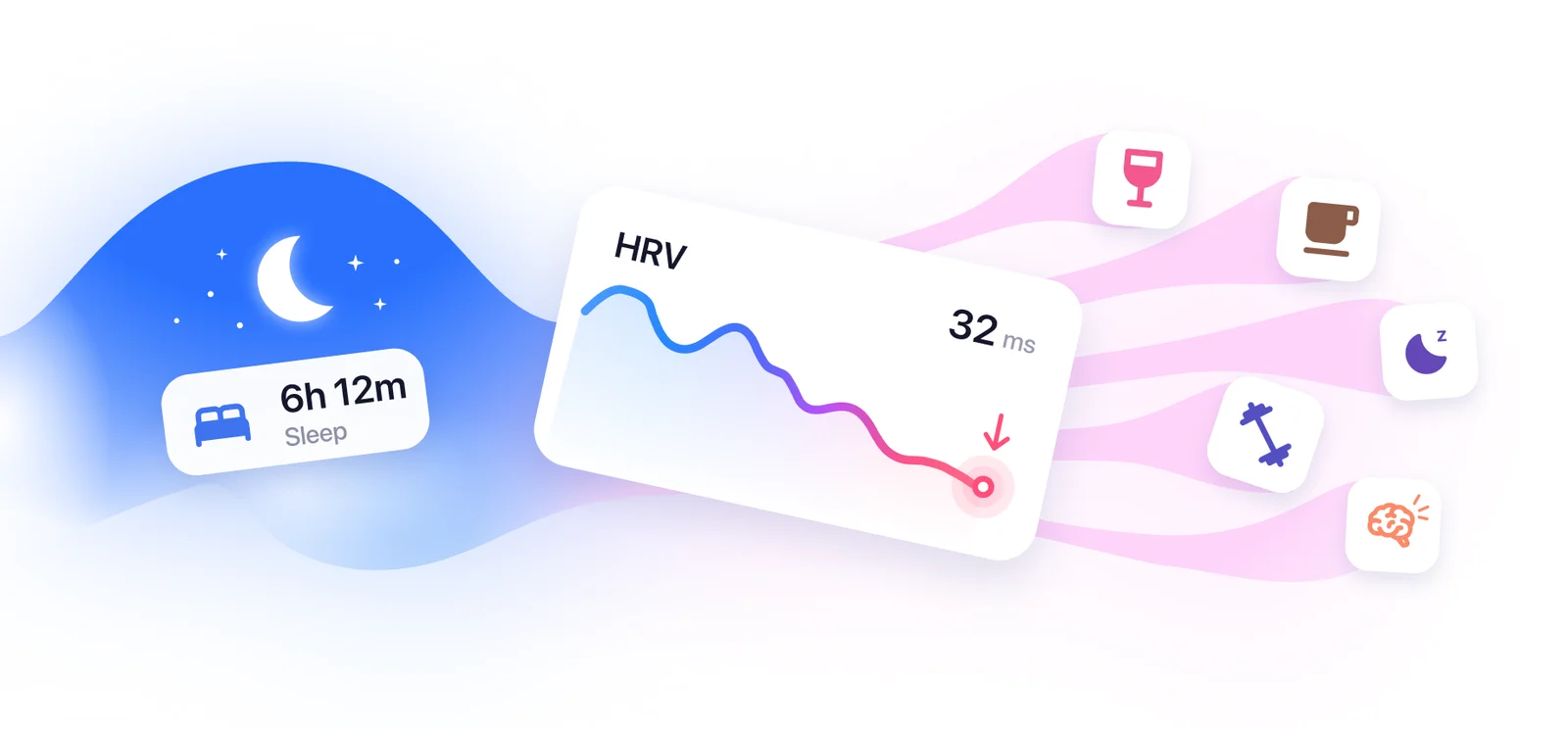
The harder question isn’t whether your HRV dropped.
It’s why yours did.
- One low reading does not mean something is wrong. Night to night variation is normal, and a single reading carries measurement noise.1213
- HRV varies enormously between people. In 8.2 million wearable users it fell steadily with age and swung across the day, so someone else’s number tells you little about yours.11
- The comparison that matters is with your own baseline, measured on the same device, in the same way. An Apple Watch number and an Oura number are not the same measurement.1416
Why did my HRV drop?
These are the changes people ask about most, with what the research supports for each. The pill shows how strong that evidence is.
What could have lowered your HRV
Nine changes, graded by evidence| What changed | Could it affect HRV? | What else you might notice |
|---|---|---|
| Alcohol | Yes, and it scales with the dose.In 20,968 WHOOP users, each drink above a person’s usual was linked with roughly 3 to 4 ms lower overnight HRV. Drinking earlier and sleeping longer softened it.12 Strong evidence | Higher resting heart rate overnight, shorter sleep, a lower readiness or recovery score. |
| Hard training | Yes, usually for a day or more.After intense aerobic sessions, parasympathetic activity can take 24 to 48 hours or longer to return, with wide individual differences.4 Strong evidence | Elevated resting heart rate, heavy legs, a low reading the night after a race or intervals. |
| Less or fragmented sleep | Yes, in controlled studies.Across 11 trials, RMSSD (the metric Oura and WHOOP report) fell after sleep deprivation. SDNN (Apple Health’s long-standing metric) did not change significantly.3 Moderate evidence | Shorter sleep on the tracker, a later bedtime, more time awake in the night. |
| Acute stress | Likely.Across 37 studies, HRV changed in response to induced stress, mostly measured during or shortly after it rather than the next morning.5 Moderate evidence | A racing mind at bedtime, a late working evening, a higher daytime heart rate. |
| Illness | Yes, sometimes before you feel it.In 297 healthcare workers wearing an Apple Watch, HRV patterns shifted up to seven days before a positive COVID test. A group-level model, not a diagnosis.6 Moderate evidence | Higher resting heart rate, skin temperature and respiratory rate on your device. |
| Travel and altitude | Altitude, yes. Travel itself, less studied.Across 15 studies, HRV fell markedly in the first week above 2,500 m.7 Ordinary travel tends to act through sleep timing, alcohol and stress. Moderate evidence | A late arrival, a different bed and time zone, a rough night or two. |
| Menstrual cycle | Yes, for many people.Across 37 studies, vagal HRV was lower in the luteal phase than the follicular phase, with large differences between individuals.8 Moderate evidence | Slightly higher resting heart rate and temperature in the second half of the cycle. |
| Late meals | Mixed.Small studies suggest late or heavy evening eating can shift the overnight autonomic rhythm; intervention results conflict.9 Limited evidence | A later dinner, a higher heart rate in the first hours of sleep. |
| Dehydration | Small studies only.Mostly after exercise in the heat, where dehydration lowered HRV. No large real-world evidence on ordinary daily hydration.10 Limited evidence | A higher resting heart rate, especially after a hot day or a hard session. |
What this meansThis table explains what can lower HRV. It cannot tell you which one lowered yours. On most mornings with a low reading, more than one of these happened at once.
How to read: “could affect” means the change has been linked with lower HRV in published research, not that it caused yours. Sources 1 to 10.Lucie Research · September 2026
Is it actually unusual for you?
HRV is one of the most individual numbers a wearable produces. In an analysis of 8.2 million Fitbit users, it fell steadily with age, differed between men and women on some metrics, and swung across the day.11 That is why there is no universal good HRV. Age, physiology, how the number is calculated, when it is measured and which device measured it all move the figure.1416
Check it here. Type this morning’s reading and your recent nights from one device, tick what happened the day before each one, and take the result with you.
Was it something you did yesterday?
Runs in your browserThe card is a 1080 × 1350 image for your camera roll. The log is a CSV you can keep adding to in Numbers, Sheets or Excel. Nothing you enter leaves this page.
What this means
How to read: your usual range is the average of your earlier nights plus or minus one standard deviation, which covers about two thirds of a typical person’s nights. Tag comparisons need at least three nights in each group, show associations rather than causes, and cannot separate tags that often happen together. Illustrative example nights are loaded until you replace them.Lucie Research · September 2026
Rather not fill this in every morning? Connecting a wearable and your calendar to Lucie gives it the nights and the context on its own.
In athletes, a seven-day average of HRV tracked how they were responding to training. Isolated daily readings did not.12 Your device’s own noise matters too. In an independent laboratory night, single-night HRV disagreed with ECG by anywhere from about 5 ms to more than 20 ms depending on the device and how it sampled.13 Small day to day changes can also fall within normal measurement variability, which is another reason to pay more attention to repeated patterns than a single morning. Our most accurate wearable 2026 report includes a small tool that checks whether a change is bigger than your device’s usual error.
Your wearable sees the drop. It doesn’t see your whole day.
A wearable measures your body in isolation. It cannot know that yesterday held five and a half hours of meetings, a hard run at 18:20 and a phone that stayed on until 00:41. Lucie can, when you choose to connect those parts of your life. It doesn’t decide what caused the drop. It shows what was happening around it and asks whether you want to keep watching.
Your HRV is lower than your recent range this morning. Yesterday also included less sleep, a harder run and a later night than usual. One night isn’t enough to know which mattered most. Want me to watch whether this pattern repeats?
Illustrative example. Lucie connects context and preserves uncertainty. It never claims to know the cause, and you decide.
What if my HRV is low but I feel fine?
Trust both signals, and don’t let one reading run your day. A single low HRV can appear on a morning you feel completely normal, because the number reflects the night just passed, includes measurement noise and moves for reasons that have nothing to do with how you will feel or perform.1213 Feeling fine is real information too. The useful question is whether the reading is unusual for you and whether it repeats. A low value that still sits within your normal spread is your baseline, not a warning. A run of low readings alongside feeling worse is a pattern worth noticing. Whether or how to train is your call, ideally with anyone who advises you on your health.
When is a low HRV worth paying attention to?
HRV on its own doesn’t diagnose illness, overtraining or any medical condition. What deserves attention is a persistent change from your own normal pattern, especially alongside symptoms: feeling unwell, unusual fatigue, a resting heart rate that stays high. If you have symptoms, or a change that persists without an obvious reason, speak with a doctor or another appropriate healthcare professional. The number is a prompt, not a verdict.
Your HRV is a number.Your life is the context.
Your wearable can tell you that something changed. Lucie helps you understand what was happening around it.
Your HRV has tended to be lower after days with late training and shorter sleep. You have another late session tonight. Want me to find an earlier time?
Illustrative example. “Has tended to” describes an association Lucie noticed in your own data over time, not a cause.
Your wearable gives you the data.Lucie helps you know what to do with it.
A few things you might be wondering.
Why did my HRV suddenly drop?
Usually one or more recent changes: alcohol, a hard session, less sleep, a stressful day, travel, the first hours of an illness, or the phase of your cycle. Normal variation also produces low mornings for no reason you can name. Compare the reading with your own recent range rather than with anyone else’s number, and see whether it repeats.
Can poor sleep lower HRV?
In controlled studies, yes. A 2025 meta-analysis of eleven trials found the vagal metric RMSSD fell after sleep deprivation, while SDNN did not change significantly.3 Real-world evidence is thinner and depends on which metric your device reports. Shorter sleep after drinking also deepened alcohol’s effect in a study of nearly 21,000 wearable users.1
Does alcohol lower HRV?
Yes, and the effect scales with the dose. In 20,968 WHOOP users, each drink above a person’s usual was linked with roughly 3 to 4 ms lower overnight HRV and a higher resting heart rate. Drinking earlier and sleeping longer softened the effect.1 An earlier Finnish study of 4,098 employees found the same dose dependence in the first hours of sleep.2
Can hard exercise lower HRV?
Yes, temporarily. A review of aerobic exercise studies found parasympathetic activity could take about a day to return after easier sessions and two days or more after intense ones, with large individual differences.4 A lower HRV the night after a hard run is an expected response, not necessarily a problem. Whether it recovers over the following days is more informative.
Why is my HRV low even though I feel fine?
Because the number reflects last night’s physiology plus measurement noise, and both can move without changing how you feel. A single reading can sit below your usual range and mean very little.1213 Feeling fine is real information. The more useful test is whether the reading is unusual for you and whether it repeats over several days.
What is a good HRV?
There is no universal good HRV number. HRV falls with age, differs by sex on some metrics and swings across the day, and in 8.2 million wearable users the spread between healthy people was very wide.11 Devices also calculate it differently. What is usually more useful is understanding your own range on the same device and noticing meaningful changes from that pattern.
Should I worry about one low HRV reading?
No. A single low value is expected from time to time. In athletes, weekly averages predicted how people were responding to training when isolated days did not.12 Watch the trend over a week or two. Persistent lows, especially with symptoms, are worth a conversation with a healthcare professional.
Why is my Apple Watch HRV different from Oura or WHOOP?
They measure different things at different times. Apple Health’s long-standing HRV type is SDNN, sampled through the day and night, while Oura and WHOOP report RMSSD from sleep.1416 Apple’s newest watches add a second variant, Recovery HRV, compared against your own baseline.15 Compare each device with itself, never with another.
Can HRV tell me if I’m sick?
Sometimes it shifts before symptoms: in 297 healthcare workers, Apple Watch HRV patterns changed up to seven days before a positive COVID test.6 That was a research model across a group, not a diagnosis for one person. A low reading doesn’t mean you are ill, and a normal one doesn’t mean you are not. Symptoms, and a healthcare professional, decide.
How do I find my HRV baseline?
Use one device, the same nightly measurement, and at least a week or two of nights. The average of those nights is your baseline, and the spread around it is your usual range. The tool above works this out from the nights you enter and lets you tag what happened the day before, so a morning can be judged against your own pattern rather than a population chart.
Can Lucie tell me why my HRV dropped?
Not with certainty, and it won’t pretend to. Lucie can connect supported wearable measurements with other context you choose to connect, such as sleep, calendar, training, attention and reflections, and help surface patterns over time. It will not claim that one event caused an HRV change unless the evidence in your own data supports that conclusion. You decide what to do with what it notices.