Europe’s Greatest AI Opportunity Is to Put Humanity First
Why the next chapter of artificial intelligence should be measured by the lives it improves, not only the wealth it creates.
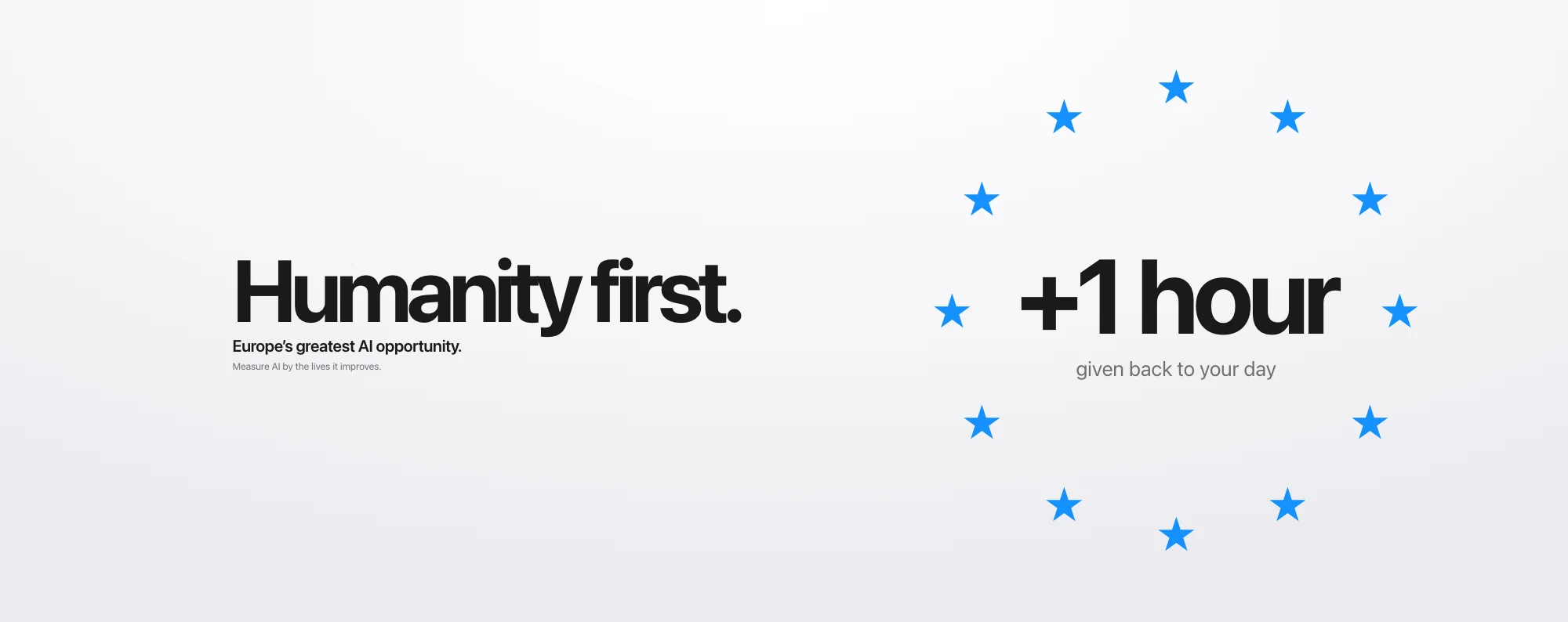
Artificial intelligence is one of the most extraordinary technological opportunities of our lifetime. I have spent years following its evolution, watching what began as research and technological experimentation become something capable of transforming entire industries. What excites me most today is that we are finally approaching a moment when intelligence can move beyond demonstrations, benchmarks and impressive technical achievements to become something genuinely useful in people’s everyday lives. We are beginning to see what happens when technology doesn’t simply provide us with more information, but helps us navigate the complexity of being human.
Yet when I look at the conversation surrounding AI, I sometimes wonder whether we are paying enough attention to its greatest promise. Much of the discussion is dominated by investment rounds, market valuations, the enormous infrastructure being built and the race to develop increasingly powerful models. We celebrate companies reaching extraordinary valuations, investors deploying billions and the possibility of creating an entirely new economic order. There is nothing inherently wrong with this excitement. Investment is necessary for innovation, and the ambition behind today’s AI breakthroughs is remarkable. But I believe there is a risk that we become so fascinated by the wealth artificial intelligence might generate that we forget to ask what it should ultimately make possible for humanity.
This tension is becoming increasingly visible. In October, the International Monetary Fund warned about the financial vulnerabilities associated with the AI investment boom, including growing leverage and the possibility that expectations could outpace economic returns.1 At the same time, the IMF recognised AI’s enormous potential to improve productivity and economic growth. Both realities can coexist. We can be witnessing the beginning of a profound technological revolution while also experiencing speculative excess around its development. The question is whether we can distinguish the financial excitement of a new industry from the lasting value it creates for society.
For me, that distinction is essential. I don’t believe the greatest achievement of artificial intelligence will be measured by the number of trillion dollar companies it creates. I believe it will be measured by how much better people are able to live because intelligence has become accessible to them. And that requires us to ask a question that should be at the centre of every conversation about the future of AI: what kind of society do we actually want to build with all this intelligence?
From artificial intelligence to a more intelligent society
For much of the digital era, technological progress has been measured by what computers can do. We made them faster, more connected and increasingly capable of processing information. We built platforms that transformed communication, commerce, entertainment and work. These developments created extraordinary opportunities, but they also introduced new forms of complexity into everyday life. We have more information than ever, yet many people feel overwhelmed by it. We have more ways to communicate, yet maintaining meaningful relationships still requires attention and effort. We have powerful digital tools, yet managing our finances, health, responsibilities and personal ambitions can feel like an increasingly demanding occupation.
Artificial intelligence gives us an opportunity to reconsider that relationship. Instead of asking how much more time people can spend interacting with technology, we can begin asking how much time technology can give back to them. Instead of designing systems primarily around engagement, we can design them around usefulness, independence and human wellbeing. Imagine an intelligence that helps someone navigate an unfamiliar healthcare system, supports a student in learning at their own pace, simplifies the administrative responsibilities of a family or helps an individual make more informed financial decisions. None of these experiences requires technology to become the centre of someone’s life. In fact, their greatest value may be that technology becomes less visible while life becomes easier.
This is what I find so exciting about the emergence of personal AI. For the first time, we can begin imagining intelligent systems that understand enough context to offer meaningful support across different parts of our lives. Not simply answering questions, but helping people act on what matters to them. Not replacing human judgement, but strengthening it. Not creating another source of distraction, but helping us recover the freedom to direct our own attention. The ambition should not be to make human beings dependent on increasingly intelligent machines. It should be to make human beings more capable because those machines exist.
At RHISE AI, this philosophy is central to why we are building Lucie, a personal AI designed to help people live with greater intention, clarity and freedom. We believe technology should serve people’s lives rather than continuously compete for their attention. That belief influences how we think about the experiences we create, the relationship between intelligence and personal data, and the responsibility that comes with building systems capable of understanding individuals. We are still at the beginning of this journey, but I believe the direction matters enormously. The future of personal AI should be built around the interests of the person using it.
Why Europe has an opportunity to lead
This is where I believe Europe has something particularly important to contribute. Europe has a long tradition of defending human dignity, individual rights, privacy and social responsibility. These principles have shaped our institutions, our understanding of freedom and our expectations of the relationship between individuals, companies and society. We have not always implemented them perfectly, and Europe faces real challenges in turning its scientific and technological strengths into globally competitive businesses. But I believe these values can become an extraordinary advantage in the next chapter of artificial intelligence.
The European Union’s AI Act reflects an attempt to establish a framework in which innovation and the protection of fundamental rights can coexist.2 Regulation alone will not make Europe a leader in AI, and we should be careful not to confuse creating rules with creating progress. We need ambitious founders, stronger investment ecosystems, world class infrastructure and the determination to build technology that can compete internationally. Europe cannot afford to become a continent that only regulates technologies developed elsewhere. We need to build, experiment, invest and take risks. But we also have an opportunity to demonstrate that technological ambition and human responsibility are not opposing forces.
I don’t believe Europe needs to reproduce Silicon Valley to succeed. We can learn enormously from the extraordinary innovation coming from the United States and from the advances being made across Asia, while contributing our own understanding of what progress should mean. The next generation of successful technology companies may be distinguished not only by the intelligence of their systems, but by the trust they establish with the people using them. Privacy, transparency, individual control and human wellbeing can become genuine product advantages when they are reflected in how technology actually works.
This is especially important as AI becomes more personal. The more an intelligent system understands about someone’s life, the greater its responsibility to protect that person’s interests. Trust cannot simply be a sentence in a privacy policy. It needs to be reflected in business models, product decisions and the degree of control individuals retain over their information and their choices. I believe Europe has an opportunity to help establish these expectations as a foundation for the intelligent society we are beginning to build.
The real measure of progress
One of the most interesting consequences of AI is that it may force us to reconsider how we measure technological success. For decades, many digital businesses have been rewarded for capturing attention, increasing engagement and encouraging people to spend more time within their platforms. That model has created extraordinary economic value, but it has also introduced a tension between what benefits a platform and what benefits the person using it. With personal AI, we have an opportunity to design a different relationship, one in which the success of technology is increasingly connected to the value it creates outside the screen.
If an intelligent assistant helps someone recover an hour of their day, spend more time with their family, understand their health or pursue an ambition they previously struggled to organise, that is meaningful progress. If AI makes education more accessible, helps small businesses compete or reduces the complexity of essential services, its contribution extends far beyond the revenue of the company providing it. These improvements may not always generate the same excitement as a major funding announcement, but collectively they could transform how people experience modern life.
I believe some of the most valuable companies of the next decade will emerge from solving these human problems at extraordinary scale. There is no contradiction between building financially successful businesses and building technology that genuinely improves lives. In fact, I believe the most sustainable form of technological progress is one in which economic value follows the creation of human value. The opportunity is not to reject capitalism, investment or competition, but to direct our extraordinary capacity for innovation towards outcomes that make society more prosperous, more capable and more free.
We are entering a period in which intelligence will become increasingly accessible, powerful and integrated into everyday experiences. The decisions we make now, as founders, engineers, investors and policymakers, will influence whether that intelligence primarily reinforces existing systems or helps us imagine better ones. Europe has an opportunity to participate in shaping that future with both ambition and conviction, showing that protecting people and advancing technology can be part of the same mission.
I have never been more excited about the possibilities of artificial intelligence. Not because of the valuations we are seeing or the enormous financial opportunity it represents, but because we are beginning to see how directly it can improve the human experience. For the first time, many of the ideas that once belonged to science fiction are becoming practical possibilities, and we have the chance to decide what purpose they should serve.
The question is no longer simply how intelligent our technology can become. It is how much more capable, independent and fulfilled human beings can become because of it. If we get that right, the greatest legacy of artificial intelligence won’t be the machines we created or the wealth they generated. It will be the society we were able to build with them.