We spent a generation engineering addiction. Thank you, Brussels.
Europe’s Digital Fairness Act asks technology to give us our lives back.
More than a decade ago, Jeff Hammerbacher, an early Facebook engineer, observed that some of the brightest minds of his generation were spending their time figuring out how to make people click on advertisements.1 It was a remarkable observation, not because advertising was inherently wrong, but because it revealed where an extraordinary amount of human intelligence was being directed. We had developed technologies capable of connecting billions of people, democratising knowledge and transforming how humanity communicates. Yet some of our greatest engineering efforts were being spent figuring out how to keep people looking at their screens for a few seconds longer.
The average internet user, every day
6h 38m online, out of about 16 waking hours
In many ways, that observation became the story of an entire generation of technology. We built extraordinary products, created entirely new industries and made services available to billions of people at little or no direct cost. These achievements deserve recognition. But somewhere along the way, we began confusing engagement with value. The number of minutes someone spent inside an application became a measure of success, regardless of whether those minutes contributed anything meaningful to their life.
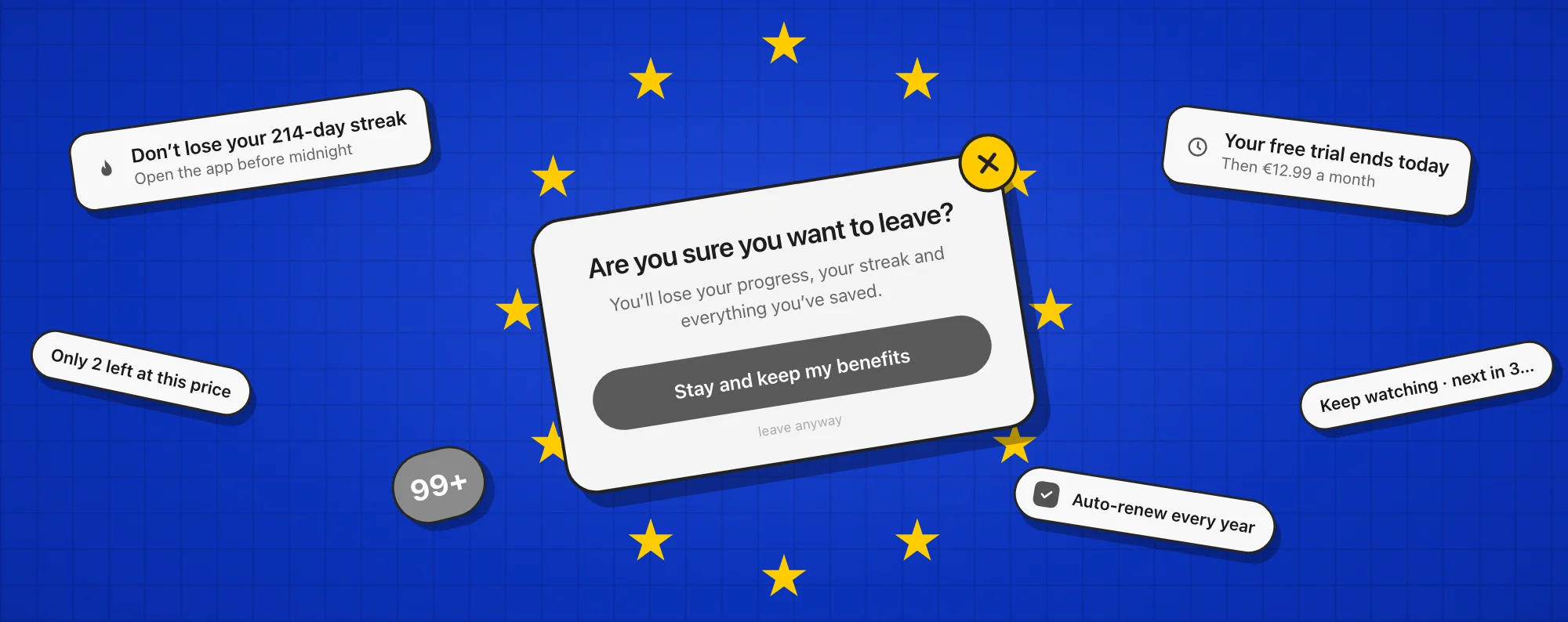
The consequences are now familiar to almost everyone. Infinite feeds that never reach an end. Notifications designed to interrupt whatever we are doing. Streaks that turn taking a break into a small psychological failure. Free trials that quietly become paid subscriptions. Cancellation processes that somehow require more effort than signing up in the first place. We have become so accustomed to these experiences that we rarely question why they exist.
97%
of the most popular websites and apps used in the EU had at least one dark pattern.
Most used several at once.
The five most common
- 1Hidden informationThe real cost, or the “no”, is buried or greyed out.
- 2PreselectionBoxes ticked for you: add-ons, newsletters, auto-renew.
- 3NaggingThe same pop-up, again and again, until you say yes.
- 4Difficult cancellationOne tap to join, five screens and a guilt trip to leave.
- 5Forced registrationNo account, no checkout.
Yet none of this happened by accident. These mechanisms were designed, tested, refined and optimised by intelligent people working within economic systems that rewarded their effectiveness. And they worked remarkably well. The technology industry became exceptionally good at capturing human attention, even when doing so came at the expense of the very people it was supposed to serve.
Perhaps the most important question we can now ask is whether capturing more of someone’s attention should ever have been the ultimate measure of technological success.
Europe is asking the right question
On 11 November 2026, the European Commission proposed the Digital Fairness Act, an initiative intended to address manipulative commercial practices in digital environments. The proposal targets issues including addictive design, dark patterns, unfair personalisation and subscription practices that exploit consumers rather than serve them.
How we got here
Six years from question to proposal. It isn’t law yet.
- New Consumer AgendaThe Commission asks whether online is as fair as offline.
- Fitness Check startsEU consumer law is tested against the digital world.
- The verdictDark patterns and addictive design are flagged as gaps.
- DFA proposedRules on addictive design, dark patterns and subscription traps.
- Parliament and CouncilDebated, amended, then voted into law.
As people who build technology, we want to say something that might sound unusual coming from our industry: thank you, Brussels. This conversation is long overdue.
The proposal is not yet law, and its details will be debated by the European Parliament, member states, consumer organisations and technology companies. Those discussions matter. Regulation must be proportionate, understandable and carefully designed to avoid unnecessarily burdening smaller companies. But the underlying principle deserves recognition. Digital products should not succeed by making people less capable of exercising their own choices.
For too long, we have treated human attention as an unlimited resource available for extraction. But attention is not simply another commodity. It is how we experience life. It is how we learn, create, build relationships, discover new interests and spend time with the people we love. Every minute of attention directed towards something is a minute that cannot simultaneously be directed elsewhere.
When a digital product deliberately exploits psychological vulnerabilities to keep someone engaged, the cost cannot be measured exclusively in screen time. It also affects that person’s freedom to decide how they want to spend their life.
This is why the Digital Fairness Act represents something more significant than another set of consumer protection rules. It reflects a growing recognition that the relationship between people and technology needs to evolve. The question is no longer simply whether digital services are accessible, convenient or entertaining. We must also ask whether they respect the people using them.
The problem isn’t technology. It’s what we reward.
It would be easy to turn this conversation into a criticism of technology companies, their founders or the engineers who build their products. But that would miss the deeper issue. The technology industry is filled with talented people who genuinely want to create useful things. Many of the products we use every day have improved our lives in extraordinary ways.
The challenge is that business models shape behaviour. When revenue depends primarily on advertising impressions, more attention generally creates more opportunities to generate revenue. When investors measure success through daily active users, session duration and retention, teams naturally optimise their products around those metrics. Over time, an entire industry develops a shared understanding of what success looks like, even when those measures do not necessarily reflect improvements in people’s lives.
This creates a difficult contradiction. A product can become more commercially successful while becoming less beneficial to the person using it. A social platform can increase engagement while leaving users feeling more distracted. An application can improve retention by making people anxious about losing a streak. A subscription service can reduce cancellations by making the cancellation process deliberately confusing.
None of these outcomes necessarily indicates that the underlying technology is better. They indicate that the company has become better at influencing behaviour.
What the attention economy measures
- Daily active users
- Minutes per session
- Notifications opened
- Streaks kept alive
- Cancellations prevented
What people actually want from it
- Time given back
- Decisions you made yourself
- Tasks actually done
- Evenings off the phone
- Trust that it works for you
And this is where thoughtful regulation can help. When an entire industry faces similar economic incentives, asking individual companies to voluntarily abandon profitable practices is rarely sufficient. Common standards can change what businesses compete on. They can reward genuine usefulness, transparency and customer satisfaction instead of manipulation.
Some argue that this kind of regulation threatens innovation. We believe the opposite can be true. Innovation should not depend on someone’s inability to leave a product they no longer want. A company should succeed because people value what it creates, not because it has become exceptionally good at exploiting their habits or vulnerabilities.
The objective should not be to make technology less ambitious. It should be to direct that ambition towards better outcomes.
A different vision for personal technology
At RHISE AI, we believe we are entering a new era in which the relationship between humans and technology can be fundamentally reimagined. Artificial intelligence creates an opportunity to move beyond products that constantly demand our attention towards systems that actively help us protect it.
Consider how much of modern life is spent managing the complexity created by our digital environments. We receive hundreds of notifications, manage countless subscriptions, navigate overflowing inboxes, coordinate calendars and try to maintain healthy routines while surrounded by products competing for our time. Technology was supposed to simplify our lives, yet we increasingly find ourselves spending enormous amounts of energy managing technology itself.
What if the next generation of software could reverse that relationship? What if technology could understand what matters to us, help us make more intentional decisions and remove unnecessary burdens from everyday life? What if its success were measured not by how long we remained inside an application, but by how much freedom we gained outside it?
This is the philosophy behind Lucie, the personal AI we are building at RHISE AI. We started with a simple conviction: technology should work for your life, not make your life work for technology.
In practice, that means creating an assistant that helps people manage their time, protect their attention and navigate the complexities of everyday life. Lucie can help identify upcoming subscription renewals, prepare actions for approval, support healthier routines and help people better understand their own habits. Rather than encouraging endless interaction, our ambition is to make technology increasingly useful while requiring less of people’s attention.
Anything renewing this week that I don’t use?
One. Your meal-kit plan renews on Friday and you haven’t ordered since September. I drafted the cancellation.
2 things to approve
We have also made deliberate choices about our business model. Lucie is a paid product because we want our incentives to remain aligned with the people we serve. We do not sell people’s personal data, and we do not build our business around selling their attention to advertisers. The relationship should be simple: people choose to pay for a service because that service makes their lives better.
Of course, building technology around these principles requires constant discipline. No company becomes human centred simply by declaring itself so. These values must influence product decisions, business models, privacy practices and the way success is measured. They must remain relevant even when commercial pressures make alternative choices tempting.
But we believe this is precisely where the next great opportunity for technology lies. Artificial intelligence gives us the ability to create systems that adapt to human needs rather than continually demanding that humans adapt to technology.
Europe has an opportunity to lead
There is another reason we welcome this initiative. For years, the global conversation about technological leadership has focused almost exclusively on who can build the largest platforms, train the most powerful models or attract the greatest amount of capital. These are important measures of technological capability, but they do not tell us everything about the kind of future we are creating.
Europe has an opportunity to contribute something equally important: a vision of technological progress grounded in human agency, individual freedom and the dignity of the people using these systems.
This should not mean positioning Europe against innovation or treating regulation as a substitute for building world class technology. Quite the opposite. Europe needs ambitious founders, exceptional engineers, competitive capital markets and companies capable of reaching billions of people. We should want European technology companies to become global leaders.
But we can also ask what kind of leadership is worth pursuing.
The opportunity is not simply to build European alternatives to existing platforms. It is to help establish a different standard for what successful technology looks like. Products that people trust. Business models that do not depend on exploiting vulnerabilities. Intelligent systems that help individuals make better decisions without taking those decisions away from them.
The Digital Fairness Act cannot achieve all of this by itself. Regulation alone does not create great products, and legislation must be accompanied by entrepreneurship, investment and a willingness to experiment. But establishing clearer boundaries around manipulative practices can create more room for companies that want to compete on genuine value.
We should not underestimate how powerful that shift could become.
The best minds of the next generation
Every generation inherits the systems built by the one before it, along with the opportunity to improve them. The previous generation of technology created unprecedented abundance in information, connectivity and access. It also created an economy in which human attention became one of the most aggressively competed for resources on Earth.
The next generation has an opportunity to build upon those achievements while correcting some of their consequences.
We can use artificial intelligence to free people from unnecessary administrative work, help them understand themselves better, support their wellbeing and create more space for creativity, relationships and meaningful experiences. We can build products that encourage people to step away from their screens when there is nothing more they need to do. We can create businesses whose financial success depends on improving the lives of their customers rather than capturing an ever greater share of their time.
This is not an argument against entertainment, social media or spending time online. People should remain free to enjoy technology however they choose. Sometimes that means watching a film, playing a game or spending an evening exploring something simply because it brings them joy. The distinction is between technology that expands our choices and technology deliberately designed to undermine them.
Ultimately, we believe serving humanity is the only sustainable path for technology to become deeply integrated into our lives. As artificial intelligence grows more capable, that principle will become even more important. The systems we invite into our homes, our relationships and our most personal decisions must earn that trust by demonstrating whose interests they serve.
We hope the brightest minds of the next generation will spend less time asking how to keep people engaged for another minute and more time asking how to give them another hour of freedom, another opportunity to create, another moment with someone they love.
That is the future we are working towards at RHISE AI, and it is why we welcome the direction Europe is taking.
Because the ultimate measure of technological progress should not be how much of our lives technology manages to capture.
It should be how much more life it enables us to live.
Questions people ask about the Digital Fairness Act
What is the EU Digital Fairness Act?
A proposal from the European Commission, adopted on 11 November 2026, that updates EU consumer law for life online. It is part of a Consumer Package the Commission describes as the most significant upgrade of EU consumer protection law in over 20 years.
What does the Digital Fairness Act target?
Dark patterns and addictive design, practices that push people to overspend, personalisation that targets their vulnerabilities, misleading influencer marketing, obscure dynamic and misleading pricing, and contracts that are hard to manage online: difficult cancellations, automatic renewals, free trials that turn into paid subscriptions without a real yes, and customer service with no human to reach.
When will the Digital Fairness Act apply?
Not yet. It is a proposal. The European Parliament and EU member states have to debate, amend and agree on it before it becomes law, and only then is an application date set.
What would it change for people who use apps?
If it is adopted as proposed, apps and online shops selling in the EU would face clearer rules against designs that push you to stay, spend or subscribe without a real choice, and leaving a subscription should be as easy as joining it.