TikTok Is Worse Than Smoking.
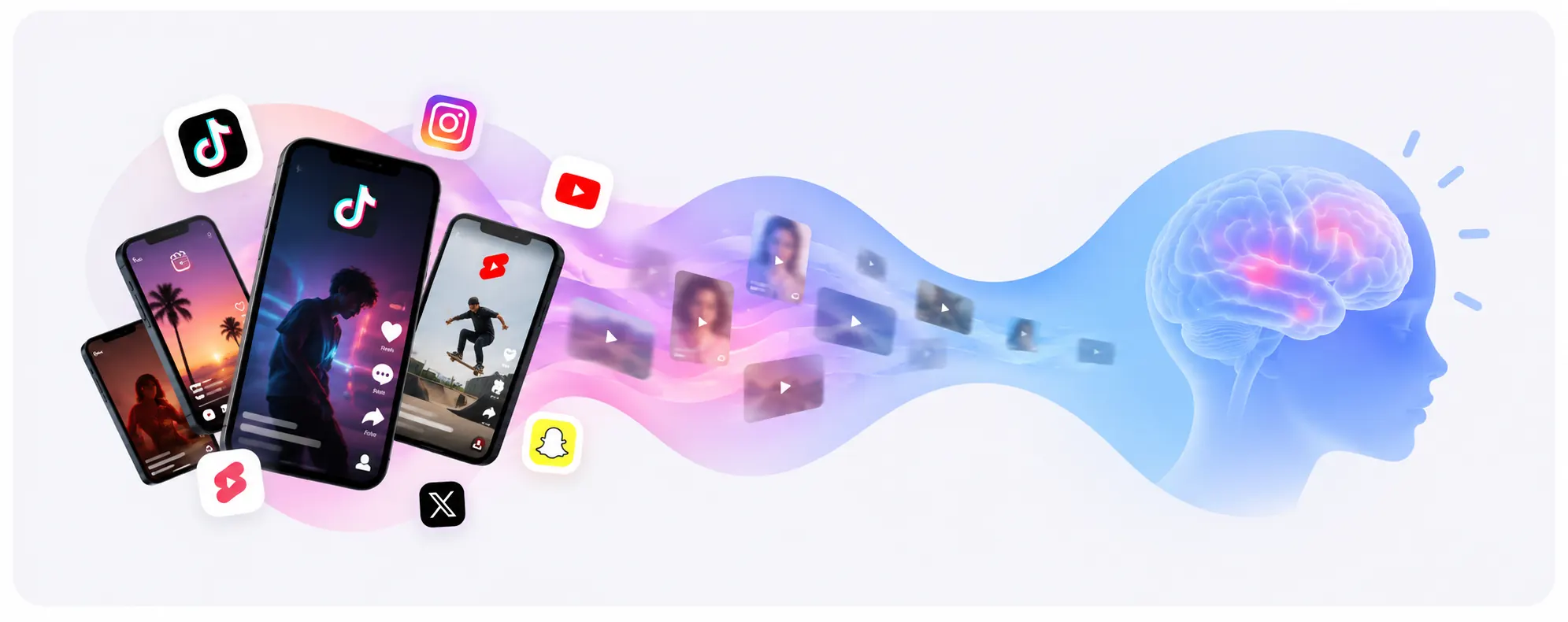
We spent decades learning how to protect our lungs from cigarettes. Now researchers are asking whether we need to start protecting our attention from the technology in our pockets.
A video circulating on TikTok recently made a provocative claim: TikTok is worse than smoking. The creator pointed to a new paper on what happens inside the brain when we watch short videos.
Taken literally, the claim is wrong. Smoking kills millions of people every year, and no study shows TikTok is more harmful than tobacco. But behind the exaggeration sits a question worth taking seriously: what is constant short video doing to our attention, and to our ability to live the lives we actually want?
Before reading on, look at your own number.
Check 01
Your scroll, over a lifetime.
Find your real number on iPhone in Settings › Screen Time › See All App & Website Activity. On Android, open Settings › Digital Wellbeing.
Assumes 16 waking hours a day, to age 80, if today’s pace stays the same.
7.5 years
of your waking life between now and 80.
Every year913 hours
In full days38 days
In working weeks23 weeks
What happens in your brain when you watch short videos?
In January 2026, researchers at Zhejiang University published a study in NeuroImage that scanned 56 young adults while they watched a stream of short videos they could keep watching or skip.1 They looked at two regions involved in cognitive control, the parts of the brain that help us monitor what we are doing and act on deliberate goals.
While people watched videos they chose to keep watching, activity in both regions dropped below baseline, more than for videos they skipped.1
That does not mean TikTok damages your brain. The authors warned against reading it as a failure of self-control, and the study shows no lasting change. But it raises a fair question: if the most engaging content quietly turns down the systems we use to decide what to do next, what happens when that becomes one of our most repeated daily habits?
We learned to protect our lungs. Now we need to protect our attention.
The epidemic nobody meant to create
The most striking thing about phone use is not how much time we spend on screens. It is how many of us want to stop and cannot.7
In September 2026, Pew Research Center published a survey of 9,750 American adults. Just over half said they spend too much time on their phone, and 45% had tried to cut back in the past year. Of those, only 25% felt very or extremely successful.2 Around four in ten said their phone hurts their sleep.3
Phone addiction is not a clinical diagnosis. Researchers speak of problematic smartphone use, when the habit becomes hard to control or starts to cost sleep, relationships or work. We believe it deserves to be treated as a public health problem rather than a pile of personal failings, because the conditions that drive compulsive use are now built into everyday life.
Check 02
The “just five minutes” check.
Think about yesterday. How often did you open an app for a quick look, and how long did those looks really last?
You are not alone. Of the 45% of American adults who tried to cut back this year, only a quarter felt highly successful.2
1 h 20 min
a day you didn’t plan to give.
Every week9.3 hours
Every year20 full days
Planned vs real20 min vs 1 h 40 min
Why can’t we stop scrolling?
A newspaper had a last page. A television programme ended. Short video removed the edges. On TikTok, Reels and Shorts the next video simply arrives, and the longer we stay, the more the feed learns what holds us. Platforms paid by advertising compete for our time, so the easiest decision is almost always to keep going.
We call this a failure of willpower. Yet we are asking people to exercise constant self-control inside environments built to sustain engagement.
On 4 October 2026, The Lancet made the same point in a three-paper series on the digital determinants of health.4 Its review of 121 reviews, covering 2,790 studies and around nine million people under 25, found consistent links between addiction-like digital media use and depression, anxiety, poor sleep and less physical activity.5 The authors are clear that this evidence cannot prove cause. But they argue that infinite scroll, autoplay and personalised feeds are deliberate design choices, and that responsibility should not rest only on the people trying to resist them.6
So is TikTok really worse than smoking?
No. Smoking’s harms are established by decades of research. The evidence on short video is newer and far less conclusive, and claiming otherwise would be irresponsible.
The comparison is useful for another reason. Cigarettes were woven into everyday life long before their harms were understood, until evidence and public health action changed our relationship with them. The parallel is not between the products. It is between two moments when society had to ask whether something enormously profitable was aligned with human wellbeing. This time we cannot just quit. We need our phones. The goal is to keep their benefits without giving up the ability to direct our own attention.
Check 03
Intentional or on autopilot?
Tap every line that sounds like you this month. Nobody sees this unless you share it.
A reflection, not a diagnosis.
0 of 6
Mostly intentional.
You mostly decide when your phone gets your attention.
- Tap the lines that sound like you.
How to stop doomscrolling
The usual advice helps: set a screen time limit, turn off notifications you don’t need, move social apps off your home screen, keep your phone out of the bedroom. It works best when it adds friction between an impulse and an action.
What lasts longer is knowing why you reach for it. Sometimes for fun. Sometimes to avoid something hard. Sometimes because you are tired, lonely or bored. And sometimes for no reason at all. Twenty minutes of videos you chose and enjoyed is fine. The problem is when twenty minutes becomes two hours you never decided to give.
So make the behaviour you want easier than the one you are fighting. Don’t chase a lower screen time number. Protect the moments that matter: your sleep before an early meeting, dinner with the people you love, the hour you set aside to focus.
Start small with Lucie
Protect the moments that matter, in three steps.
- 1Choose a moment.
The night before an early meeting. Dinner. A morning to focus.
- 2Set it up once.
Lucie pauses distracting apps through Screen Time and reminds you when it begins.
- 3Lucie watches over it.
When something important lands in your calendar, Lucie suggests protecting the time around it.
22:30
Until 07:00
You have an early board meeting and you’ve been up past midnight three nights this week. Want me to protect your sleep tonight?
Technology that gives attention back
For twenty years, technology’s intelligence went into learning what keeps us watching. Lucie reverses that objective. It connects your calendar, health data and attention to help you follow through on intentions you have already set. It does not decide what your life should look like. You do. And because Lucie is a paid product with no advertisers, it has no reason to keep you scrolling.
We spent two decades building technology that learned how to capture human attention. The challenge of the next one is learning how to give it back. The problem is not that we love our phones too much. It is that we sometimes forget how much there is to love beyond them.
No algorithm should be better at deciding how you spend your life than you are.
A few things you might be wondering.
Is TikTok worse than smoking?
No. No study shows TikTok is more harmful than smoking, whose links to cancer, heart disease and early death are established by decades of research. Research on short video is newer and less conclusive, though studies raise real concerns about problematic use, cognitive control, sleep and wellbeing.
Does TikTok damage your brain?
There is no evidence that it causes permanent damage. A 2026 NeuroImage study found reduced activity in brain regions involved in cognitive control while people watched short videos they chose to keep watching. The authors did not find lasting change or a loss of self-control.
Why is TikTok so addictive?
It combines personalised recommendations, endless scrolling, very short videos and unpredictable rewards. The next video always arrives without a decision, which makes stopping harder than starting, especially once scrolling becomes a habit.
How do I stop doomscrolling?
Notice when you scroll without meaning to, then add friction at those moments: boundaries around bedtime and focused work, fewer notifications and app limits or blockers. Protecting specific moments, like the night before an early meeting, lasts longer than willpower alone.
How much screen time is too much for adults?
There is no agreed daily limit for adults. What matters is what the time displaces and how it affects your sleep, relationships, activity and wellbeing. Hours spent working or talking with people you love are not the same as hours of compulsive scrolling.
How do I check my screen time?
On iPhone, open Settings, then Screen Time, then See All App & Website Activity. On Android, open Settings, then Digital Wellbeing and parental controls. Look at the daily average for your social and video apps, then try the checks on this page.
Can AI help reduce phone addiction?
It can when it is designed to. A personal AI connected to your calendar and Screen Time can protect the hours you set aside for sleep, focus or people, rather than only reporting how long you spent. It depends on whether the product is built to serve your attention or to capture it.