What Is a Life OS? The Future of Personal AI
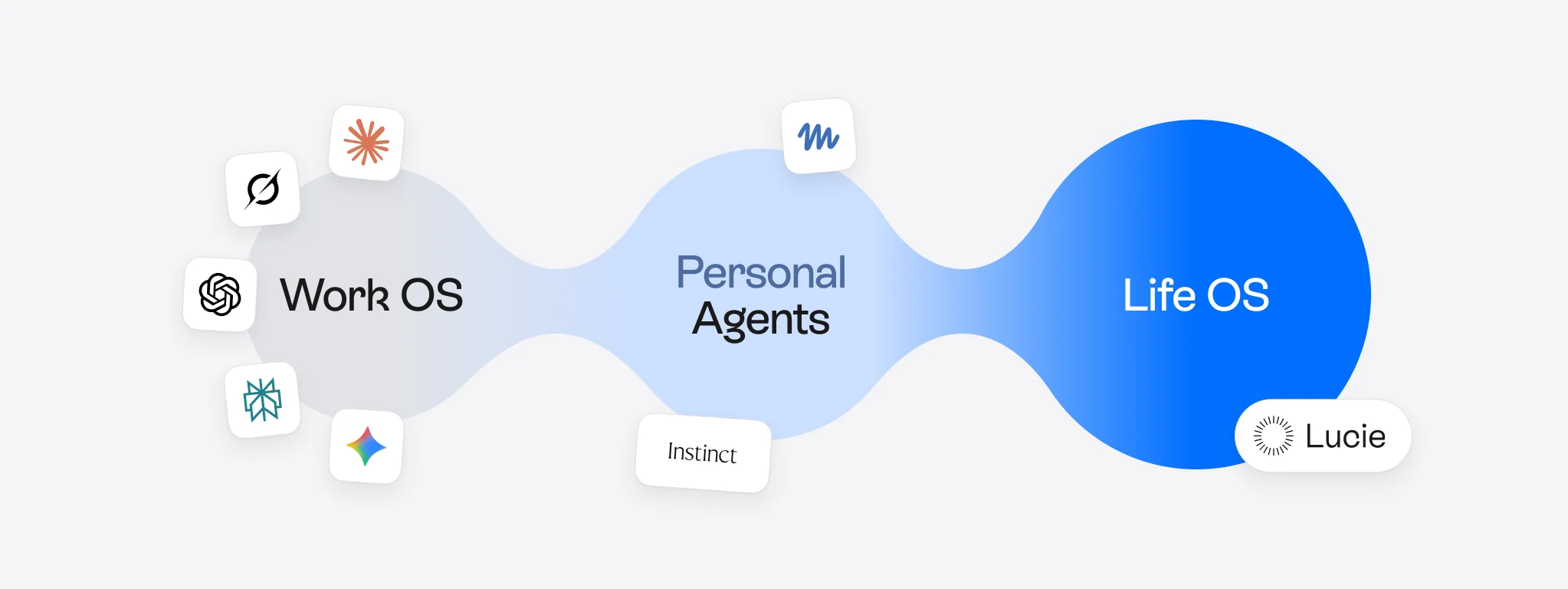
Artificial intelligence is becoming extraordinarily good at helping us work.
It can write emails, summarize meetings, research markets, prepare presentations, organize projects and increasingly complete entire workflows on our behalf. The next generation of AI agents will go further. Instead of simply answering questions, they will take actions across our digital lives.
This is a remarkable shift. But it raises a question we do not think enough people are asking.
If AI becomes incredibly good at helping us work, who is building the intelligence that helps us live?
People are already answering with their behaviour. More than 70 percent of ChatGPT messages are now unrelated to work, and the share rises the longer people use it.1
Most of the software we have built over the last few decades has been designed around output. Calendars organize our time. Project management tools organize our work. Communication tools help teams move faster. AI is now adding an extraordinary layer of intelligence on top of all of this.
You could think of this emerging ecosystem as a Work OS: an intelligent layer that understands your projects, meetings, documents, colleagues, messages and deadlines, then helps you execute.
This is no accident. As a society, we optimize for productivity: more productivity means more output, more output means more revenue, and more revenue means more shareholder value. Our tools, and now our AI, are built to serve that function.
There is enormous value in that. But becoming more efficient at work does not automatically make us healthier, happier or more present. Finishing ten more tasks does not make us sleep better. Clearing our inbox does not make us call our parents. Automating our meetings does not ensure we spend time with the people we love.
If anything, AI has made work bigger. In an eight-month Berkeley study, employees using AI worked faster, took on more tasks and stretched work into more hours, often without being asked.2
Meanwhile, the signals from society are hard to ignore. The World Health Organization estimates that one in six people worldwide is affected by loneliness, which is linked to more than 871,000 deaths a year and to depression and anxiety.3 We have become remarkably good at producing, while many of us have become more isolated.
We can become extraordinarily efficient at doing things without ever asking whether those things deserve our time in the first place.
That is why we believe AI also needs a Life OS.
The market is already moving toward personal AI. This week at Meta Connect, Mark Zuckerberg called Muse, Meta’s new personal agent, “the centerpiece of our vision.”4 Instinct, an assistant you text in iMessage, went viral on X and reached a $2.5 billion valuation within weeks.5 Before both came OpenClaw, an open-source agent built mostly by and for developers who run their own servers.6
But personal is not the same as purpose. OpenClaw, Instinct and Muse are personal agents. They know a lot about you, and they are built to get things done for you. Meta has been open about the model behind Muse. Zuckerberg said the company expects to profit over time by taking a small fee from transactions.4 That is a legitimate business, and a useful product. It also tells you what the intelligence is optimizing for: getting things done.
A Life OS starts from a different question. Not what can be done for you, but whether it deserves doing at all. A personal agent optimizes for completion. A Life OS optimizes for alignment with your health, your relationships and your intentions.
What is your AI optimizing for?
Three directions for personal AI, distinguished by what they optimize for.
- Work OS
- Personal Agency
- Life Intelligence
Helps you do
Work OS
AI that helps you work


- Context
- Primary role
- Think. Create. Execute.
“How do I get this done?”
Does it for you
Personal Agents
AI that gets things done for you


- Context
- Primary role
- Act. Book. Buy. Organize.
“What can I take off your plate?”
Helps you decide what deserves doing
Life OS
AI that helps you live intentionally
- Context
- Primary role
- Understand. Align. Protect.
“What deserves my time and attention?”
A Work OS helps you think, create and execute. Personal agents act for you. A Life OS helps you decide what deserves your time and attention in the first place. AI assistants ask: “What can I do for you?” A Life OS asks: “What matters to you right now?” It can act too, but action is a capability, not the objective.
What is a Life OS?
A Life OS is a personal intelligence layer that understands the context of your life and helps you live more intentionally.
Instead of understanding only your work, it can connect signals across your health, sleep, calendar, attention, relationships, goals and reflections. The purpose is not to turn your life into another productivity system. It is almost the opposite: to understand enough about your life that you have to spend less time managing it.
Imagine your sleep has gradually deteriorated over the last few nights while your calendar has become unusually busy. Most technology today would show you these things separately. Your wearable gives you a sleep score. Your calendar shows you six meetings. Your phone tells you how much screen time you had.
But none of them understands the whole picture.
A Life OS could.
Instead of giving you another dashboard to interpret, it could understand that you have an important morning tomorrow, help you protect your evening from distracting apps, suggest a short meditation before bed and adjust tomorrow around how your body actually feels.
The difference is subtle but fundamental.
A Work OS understands the task. Personal agents take action. A Life OS understands the human.
Life is not another task list
There is a danger in bringing the logic of productivity into every part of our lives.
Exercise becomes a task. Meditation becomes a task. Calling Mum becomes a task. Seeing friends becomes a task. Sleeping eight hours becomes another objective we somehow failed to complete.
Eventually, being human starts to resemble project management.
But a meaningful life is not a backlog waiting to reach zero. Relationships are not tasks. Rest is not wasted productivity. A walk with someone you love does not need a return on investment.
The role of personal AI should not be to optimize every second of our existence. It should remove some of the invisible coordination required to protect what matters.
This distinction will become even more important as AI agents become capable of acting for us.
Booking a restaurant is useful. Understanding that you have barely spent time with your partner recently and that tonight might be a good evening to reconnect is intelligence.
Personal agentUseful
Table for two, 20:00
Tonight
Life OSIntelligence
 Tonight
18 days
Free
You have barely had an evening together lately, and tonight is free. Want me to keep it clear for the two of you?
Moving a workout is useful. Understanding that your recovery has been declining and that today should probably be lighter is intelligence.
Personal agentUseful
CalendarStrength training
Moved to 18:30, 60 min
Life OSIntelligence
 This morning3 days below usual
41%
RecoveryYour recovery has been below your usual range for three days. Today might be better as 30 minutes of easy cardio.
Sending an email is useful. Understanding that 11:47 PM might not be the moment you should be answering it is intelligence.
Personal agentUseful
 Email
EmailRe: Q4 numbers
To David
Life OSIntelligence
Draft readyToDavid
SubjectRe: Q4 numbers
It is 23:47 and your first meeting tomorrow is with David. Want this to land at 08:30 instead?
The future of personal AI cannot simply be about what an agent can do for you. It also needs to understand what is actually worth doing.
We need all three
This is not an argument against productivity, a Work OS or personal agents. We need all of them.
Work and life are deeply connected. Poor sleep changes how you think in a strategy meeting. A stressful week changes how present you are at dinner. Exercise affects your energy. Relationships can affect your wellbeing. An overloaded calendar can eventually become a problem for your body.
A Work OS can expand our capacity to execute. Personal agents can remove things from our plate. A Life OS can help us decide where that capacity belongs.
A Work OS asks, how do we get this done?
A Life OS asks, does this deserve your time and attention?
And increasingly, these systems will need to understand each other.
There is another important difference. A Life OS cannot reach its full potential if it depends entirely on you remembering to open an app and ask it a question.
Life happens continuously. Your sleep changes. Your calendar changes. Your attention changes. Your body changes. Your priorities change.
If your personal AI only becomes intelligent once you prompt it, it is missing most of the context that makes intelligence personal.
OpenAI’s Sam Altman has described wanting ChatGPT to eventually remember everything in a person’s life.9 But memory alone does not make an AI a Life OS. The deeper question is what that context is used to optimize for. The more an AI understands about your life, the more it matters whose interests it ultimately serves.
The next generation of personal AI will therefore move from prompted intelligence to contextual intelligence. Sometimes it will answer a question. Sometimes it will take an action. Sometimes it will gently bring something important to your attention. And sometimes the most intelligent thing it can do is nothing at all.
Because an AI designed to improve your life but constantly demands your attention has misunderstood the assignment.
What should all this intelligence give us?
For decades, technology has been remarkably successful at increasing what humans can produce. AI will accelerate that dramatically. We will write faster, research faster, build faster and operate with capabilities that once required entire teams.
That is extraordinary.
But productivity cannot be the final destination.
The deeper promise of personal AI is not simply giving us the ability to do more. It is giving us back some of what modern technology has gradually consumed: our time and attention.
Time to think. Time to recover. Time with people we love. Time for our bodies. Time to explore. Time to do absolutely nothing. Time to decide what we actually want from this strange and beautiful experience of being alive.
The future should not require choosing between ambition and life. We should build systems intelligent enough to support both.
A Work OS for what you do. A Life OS for how you live.
At Lucie, we are building the latter. Not to optimize every second of your existence, but to help you protect the ones that matter.
A few things you might be wondering.
What is a Life OS?
A Life OS is a personal intelligence layer that understands the context of your life and helps you live more intentionally. It connects signals across your health, sleep, calendar, attention, relationships, goals and reflections, so you spend less time managing your life and more time living it.
What is the difference between a Life OS and a Work OS?
A Work OS understands projects, meetings, documents and deadlines, and helps you get work done. A Life OS understands the person doing the work: how they slept, who they have not seen, what they said matters this season. One asks how to get something done. The other asks whether it deserves your time.
Is a Life OS the same as a Life OS template in Notion?
No. Most Life OS templates are a set of pages for goals, tasks, habits and journals that you build and keep up to date yourself, so they only know what you type into them. A Life OS in the sense we mean is AI that learns from the sources you choose to connect and from what you tell it, so the organising happens for you rather than by you. 1011
What is the difference between a Life OS and a personal AI agent?
A personal AI agent is primarily designed to do things for you. A Life OS is designed to understand the context of your life and help you decide what deserves your time and attention. A Life OS can also take action, but action is a capability, not the objective.
What is contextual AI?
Contextual AI understands a request through everything around it: your calendar, your recent sleep, what you have said before and what matters to you. Prompted AI waits for a question and answers it. Contextual AI can bring something up at the right moment, and knows that most of the time the right moment is not now.
Do I need a wearable to use a Life OS like Lucie?
No. You do not need to connect anything. Start by talking to Lucie. Connecting more sources adds context later: today Lucie connects to Apple Health, Apple Watch, WHOOP, Oura, Suunto and Polar. Garmin and Fitbit are connected via Apple Health.
Is my personal data private?
Yes. Your personal data is encrypted at rest and cannot be read by the Lucie team, including for support purposes. You choose what you connect and can disconnect it at any time.