AI Journaling: How to Start and What the Research Says
Journaling is one of the few daily habits with decades of research behind it. Here is what the evidence says, what AI changes, and a five-minute routine you can start tonight.
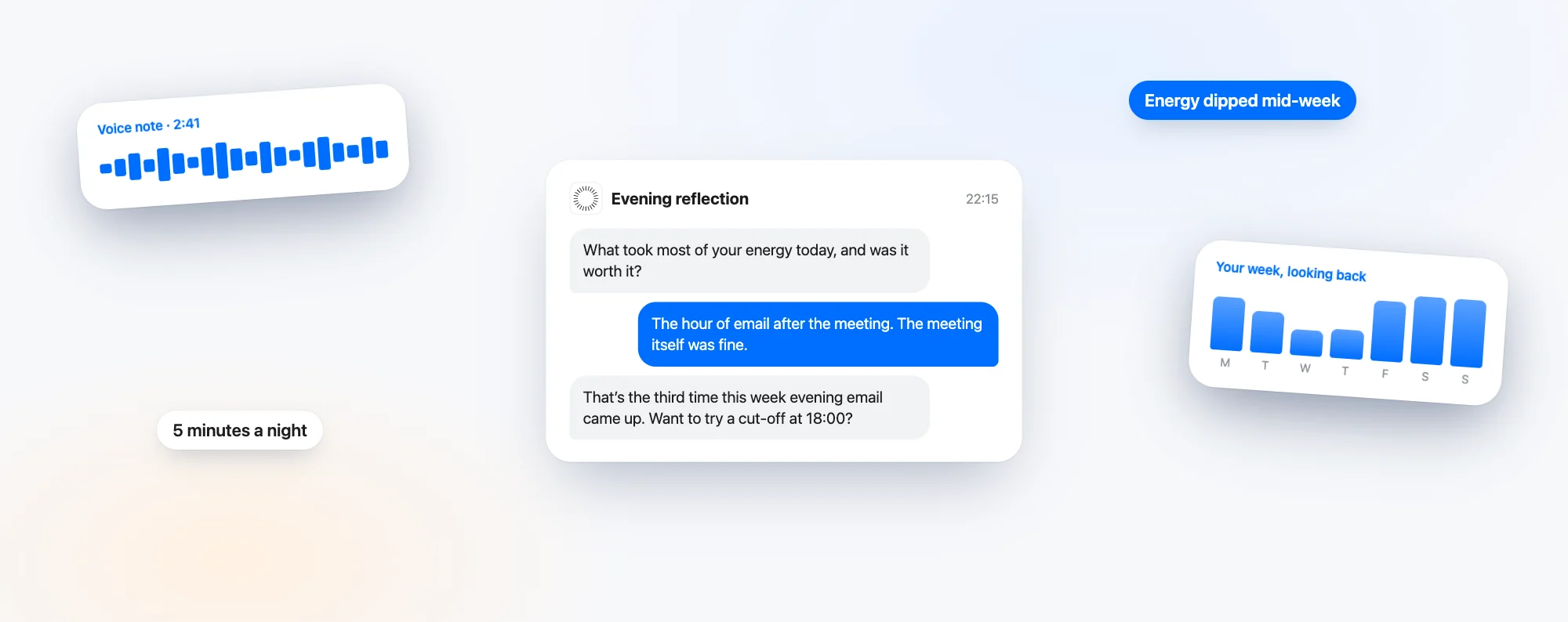
Plenty of people start a journal and give up within a week. A blank page every night is hard, and pages you never reread don’t teach you much.
AI changes both of those. It can hand you a question to start with, ask one follow-up that goes a little deeper, and, after a few weeks, show you what keeps coming back. Here is what the research actually says, and a routine that takes five minutes.
What the research says about journaling
Journaling is one of the most studied habits in psychology, mostly in the form of “expressive writing”: a few minutes of writing about your thoughts and feelings.
Writing about feelings
146 trialsAcross 146 randomised studies, writing about emotional experiences had a small but real positive effect on wellbeing.2 An earlier review of healthy adults found a medium effect.1
Well studied · modest effectGratitude lists
3 studiesPeople who regularly wrote down what they were grateful for reported more positive mood than those who listed hassles.3
Consistent on moodThe honest summary: the effects are real but modest, and they come from doing it regularly. Research on AI journaling is newer. The first studies are small and short, but they point the same way.
What AI changes
The value of a journal comes from two moments: getting started, and looking back. Those are exactly the parts people skip.
A paper journal
An AI journal
Step 1 Pick a time you already have
Don’t add a new slot to your day. Attach journaling to something you already do: after brushing your teeth, on the train home, with your first coffee.
Step 2 Start with one prompt
A good prompt is specific and a little uncomfortable. It asks about today, not your whole life.
Tonight’s prompt
What took most of your energy today, and was it worth it?
Step 3 Write or speak for three minutes
Don’t edit and don’t aim for good writing. If typing slows you down, speak instead. Many people find they say more out loud than they would ever write.
“Honestly the meeting went better than I feared. What drained me was the hour of email after it, not the meeting itself…”
Step 4 Answer one follow-up
This is where AI earns its place. Instead of stopping at the first answer, it asks one question that goes a step further, often connecting today to something you said before.
The meeting went better than I feared. What drained me was the hour of email after it.
That’s the third time this week the email after a meeting drained you more than the meeting itself. What would it take to leave that hour for tomorrow morning?
Probably just not opening my inbox after 6.
Want me to remind you at 18:00 tomorrow?
Step 5 Once a week, read the patterns
Every Sunday, spend five minutes looking back. Not at every entry, just at what repeats: what gave you energy, what drained it, what you keep mentioning.
Energy dipped mid-week, on the two days you mentioned evening email.
You felt best after time outside, mentioned on 3 of your 4 best days.
One thing to try: no inbox after 18:00 on Wednesday and Thursday.
12 journaling prompts that work
Copy these into your notes, or use them as a starting point with your AI journal.
When you’re stressed
What exactly am I worried about, in one sentence?
What part of this can I control tomorrow?
When you’re stuck
What would I do if I knew it couldn’t fail?
What am I avoiding, and why?
Gratitude
What went better than expected today?
Who made my day easier, and did I tell them?
End of the week
What gave me energy this week, and what took it?
What do I want more of next week?
Big decisions
What would I advise a friend in my position?
How will I feel about this in a year?
Relationships
Who have I been thinking about but not talked to?
What conversation am I putting off?
Before you trust an app with your journal
Your journal may be the most private thing you write. Before you pick an app, ask these five questions.
How Lucie helps you reflect
Lucie is a personal AI for iPhone and Mac. You can reflect by voice or text whenever it suits you, and Lucie remembers what you said, asks a follow-up when it helps and shows you the patterns in your reflections over time. Lucie does not train on your chats, your data is encrypted and the Lucie team cannot read it, and it is made and hosted in the EU.
How was today, really?
Tired. I said yes to three things I didn’t want to do.
That’s come up twice this month, both times on days you didn’t get outside. What’s one thing you could say no to tomorrow?
Questions people ask
Is AI journaling better than writing on paper?
Not better, different. Paper is private and distraction-free. An AI journal helps you start with a question, goes one step deeper with a follow-up and shows patterns across weeks. Many people use both.
How long should I journal each day?
Five minutes is enough. Most research used short sessions, and consistency matters more than length.
Is AI journaling private?
It depends on the app. Check whether it trains on your entries, where data is stored, whether it is encrypted and whether you can delete everything.
Can journaling replace therapy?
No. Journaling can support your wellbeing, but it is not treatment. If you are struggling, talk to a professional.